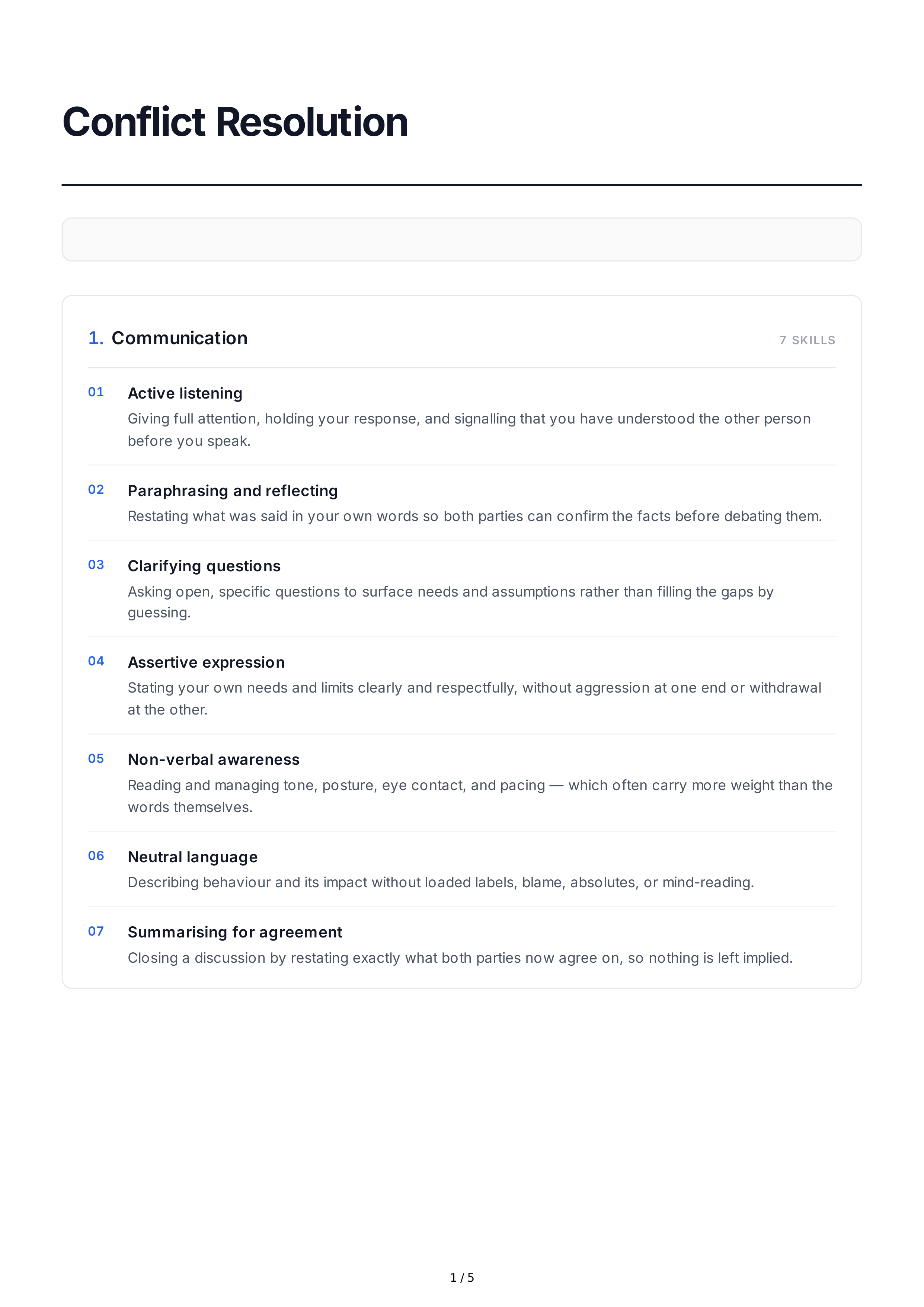
Conflict
Resolution
1.
Communication
7
SKILLS
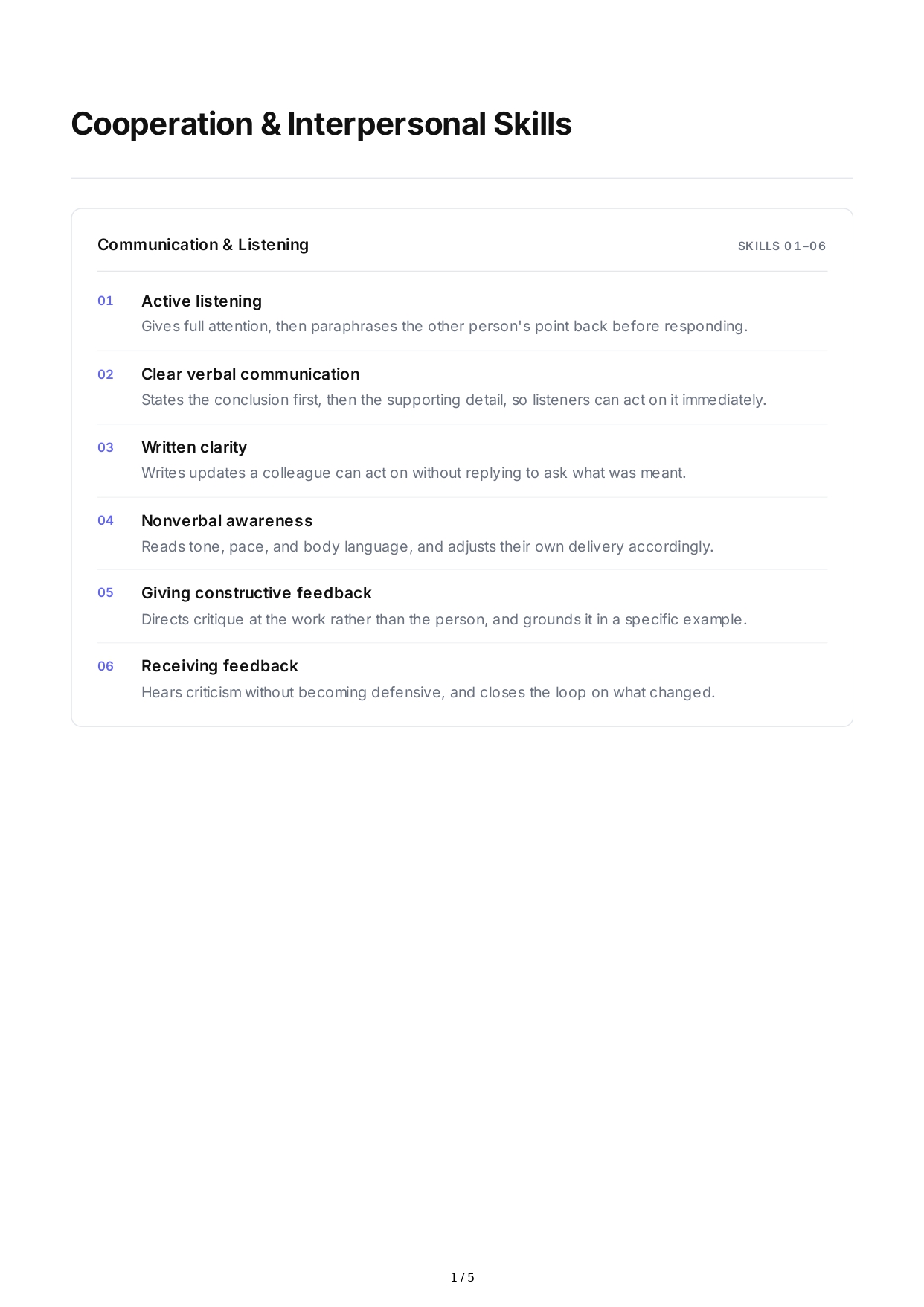
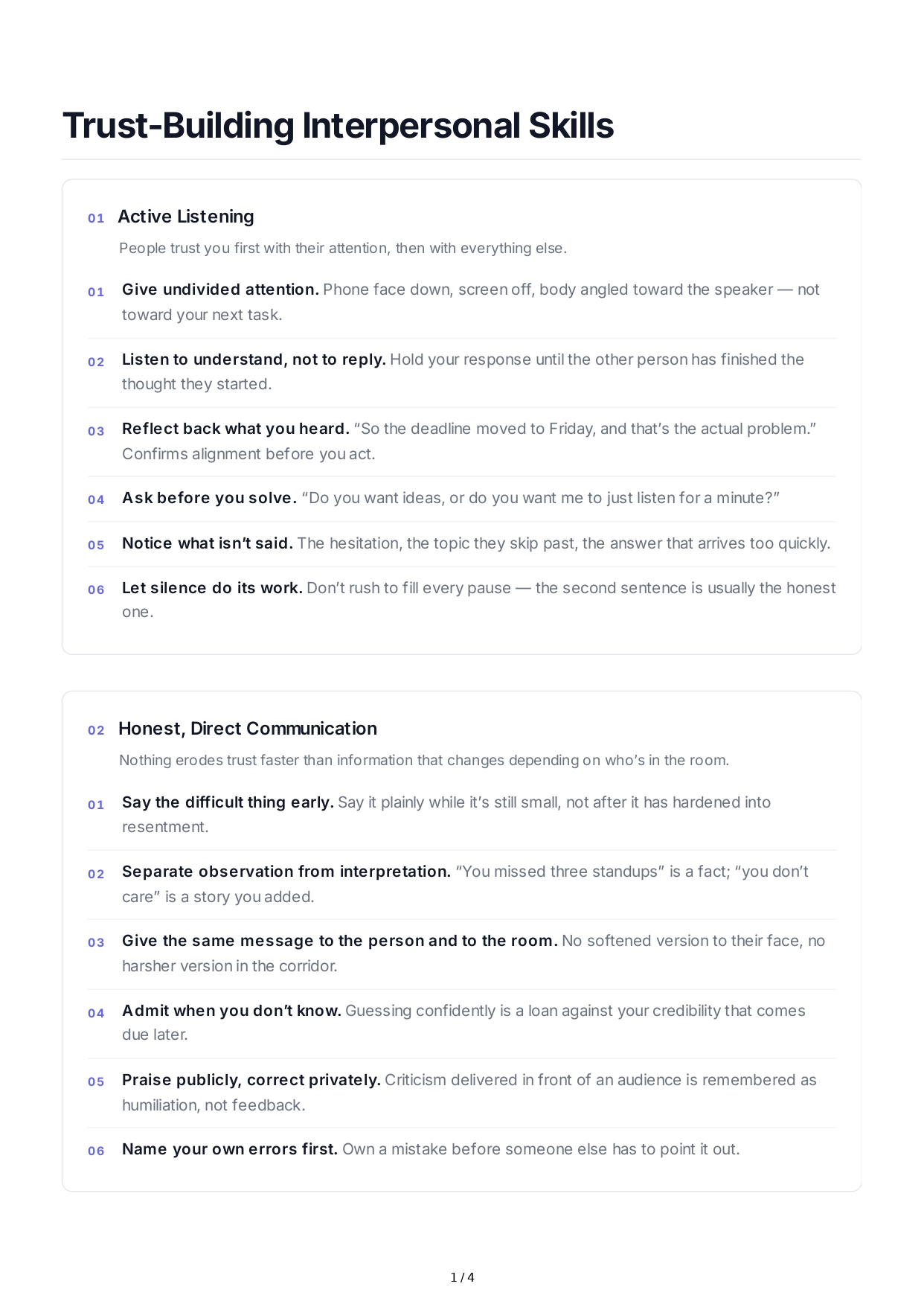
01
Active
listening
Giving
full
attention
,
holding
your
response
,
and
signalling
that
you
have
understood
the
other
person
before
you
speak
.
02
Paraphrasing
and
reflecting
Restating
what
was
said
in
your
own
words
so
both
parties
can
confirm
the
facts
before
debating
them
.
03
Clarifying
questions
Asking
open
,
specific
questions
to
surface
needs
and
assumptions
rather
than
filling
the
gaps
by
guessing
.
04
Assertive
expression
Stating
your
own
needs
and
limits
clearly
and
respectfully
,
without
aggression
at
one
end
or
withdrawal
at
the
other
.
05
Non
-
verbal
awareness
Reading
and
managing
tone
,
posture
,
eye
contact
,
and
pacing
—
which
often
carry
more
weight
than
the
words
themselves
.
06
Neutral
language
Describing
behaviour
and
its
impact
without
loaded
labels
,
blame
,
absolutes
,
or
mind
-
reading
.
07
Summarising
for
agreement
Closing
a
discussion
by
restating
exactly
what
both
parties
now
agree
on
,
so
nothing
is
left
implied
.
1 / 5
2.
Emotional
intelligence
6
SKILLS
08
Self
-
regulation
Staying
calm
and
choosing
your
response
when
you
feel
provoked
,
threatened
,
or
dismissed
.
09
Emotional
recognition
Naming
what
you
and
others
are
feeling
,
which
lowers
the
intensity
and
keeps
the
exchange
from
escalating
.
10
Empathy
Understanding
the
other
person
'
s
perspective
and
interests
even
when
you
disagree
with
their
position
.
11
Patience
and
pacing
Allowing
silence
,
taking
breaks
,
and
resisting
the
urge
to
force
a
resolution
faster
than
the
issue
allows
.
12
Tolerance
for
discomfort
Staying
in
the
conversation
when
it
becomes
awkward
instead
of
deflecting
with
humour
,
blame
,
or
a
subject
change
.
13
Impulse
control
Pausing
before
sending
the
sharp
reply
,
raising
your
voice
,
or
walking
out
of
the
room
.
2 / 5
3.
Cognitive
&
analytical
7
SKILLS
14
Perspective
-
taking
Deliberately
viewing
the
issue
from
the
other
party
'
s
position
,
constraints
,
and
history
.
15
Separating
interests
from
positions
Looking
past
stated
demands
to
the
underlying
needs
that
are
driving
them
.
16
Reframing
Restating
a
hostile
framing
as
a
shared
problem
the
two
of
you
can
work
on
together
.
17
Root
-
cause
analysis
Tracing
a
conflict
back
past
the
triggering
incident
to
the
pattern
underneath
it
.
18
Objective
criteria
Anchoring
decisions
in
standards
,
policy
,
data
,
or
precedent
rather
than
in
who
argues
hardest
.
19
Option
generation
Producing
several
possible
solutions
before
evaluating
any
one
of
them
.
20
Consequence
forecasting
Thinking
through
how
each
option
plays
out
over
time
and
for
every
party
affected
.
3 / 5
4.
Relational
7
SKILLS
21
Trust
-
building
Following
through
on
small
commitments
so
that
difficult
conversations
become
survivable
rather
than
risky
.
22
Respect
for
boundaries
Recognising
when
someone
needs
time
,
privacy
,
or
a
different
channel
before
the
conversation
can
continue
.
23
Rapport
Finding
genuine
common
ground
before
the
hard
part
of
the
conversation
begins
.
24
De
-
escalation
Lowering
volume
,
slowing
pace
,
and
reducing
perceived
threat
so
that
reasoning
becomes
possible
again
.
25
Accountability
Owning
your
own
contribution
to
the
conflict
without
over
-
apologising
or
collapsing
your
position
.
26
Repair
after
rupture
Reconnecting
and
rebuilding
after
an
argument
rather
than
letting
it
sit
unaddressed
.
27
Cultural
and
contextual
sensitivity
Reading
how
norms
around
directness
,
hierarchy
,
and
emotional
expression
differ
between
people
.
4 / 5
5.
Process
&
facilitation
7
SKILLS
28
Mediation
Guiding
two
parties
through
a
structured
conversation
while
staying
neutral
on
the
outcome
.
29
Negotiation
Trading
and
problem
-
solving
toward
an
outcome
both
sides
can
accept
and
sustain
over
time
.
30
Facilitation
Keeping
a
group
focused
on
the
issue
in
front
of
them
rather
than
on
personalities
.
31
Ground
rules
Agreeing
in
advance
on
how
the
conversation
will
be
conducted
,
before
things
get
difficult
.
32
Bias
awareness
Noticing
how
your
own
history
,
loyalties
,
and
mood
are
skewing
your
reading
of
the
situation
.
33
Consensus
building
Moving
a
group
toward
a
decision
that
everyone
can
support
and
commit
to
.
34
Follow
-
through
Documenting
the
agreement
,
assigning
ownership
,
and
checking
back
so
the
resolution
actually
holds
.
5 / 5