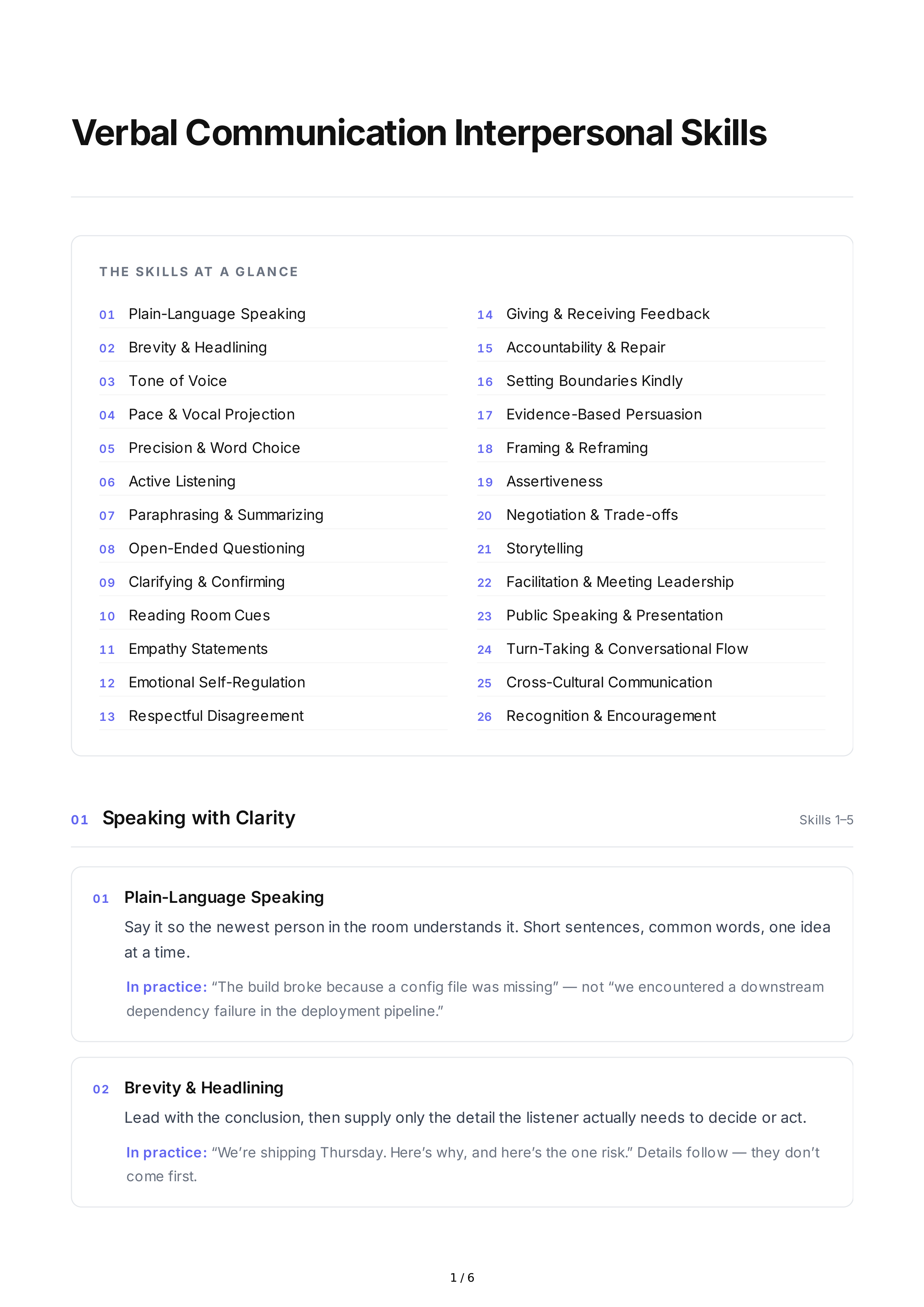
Verbal
Communication
Interpersonal
Skills
T HE
SK I LLS
AT
A
G LAN CE
01
Plain
-
Language
Speaking
14
Giving
&
Receiving
Feedback
02
Brevity
&
Headlining
15
Accountability
&
Repair
03
Tone
of
Voice
16
Setting
Boundaries
Kindly
04
Pace
&
Vocal
Projection
17
Evidence
-
Based
Persuasion
05
Precision
&
Word
Choice
18
Framing
&
Reframing
06
Active
Listening
19
Assertiveness
07
Paraphrasing
&
Summarizing
20
Negotiation
&
Trade
-
offs
08
Open
-
Ended
Questioning
21
Storytelling
09
Clarifying
&
Confirming
22
Facilitation
&
Meeting
Leadership
10
Reading
Room
Cues
23
Public
Speaking
&
Presentation
11
Empathy
Statements
24
Turn
-
Taking
&
Conversational
Flow
12
Emotional
Self
-
Regulation
25
Cross
-
Cultural
Communication
13
Respectful
Disagreement
26
Recognition
&
Encouragement
01
Speaking
with
Clarity
Skills
1–5
01
Plain
-
Language
Speaking
Say
it
so
the
newest
person
in
the
room
understands
it
.
Short
sentences
,
common
words
,
one
idea
at
a
time
.
In
practice
:
“
The
build
broke
because
a
config
file
was
missing
” —
not
“
we
encountered
a
downstream
dependency
failure
in
the
deployment
pipeline
.”
02
Brevity
&
Headlining
Lead
with
the
conclusion
,
then
supply
only
the
detail
the
listener
actually
needs
to
decide
or
act
.
In
practice
:
“
We
’
re
shipping
Thursday
.
Here
’
s
why
,
and
here
’
s
the
one
risk
.”
Details
follow
—
they
don
’
t
come
first
.
1 / 6
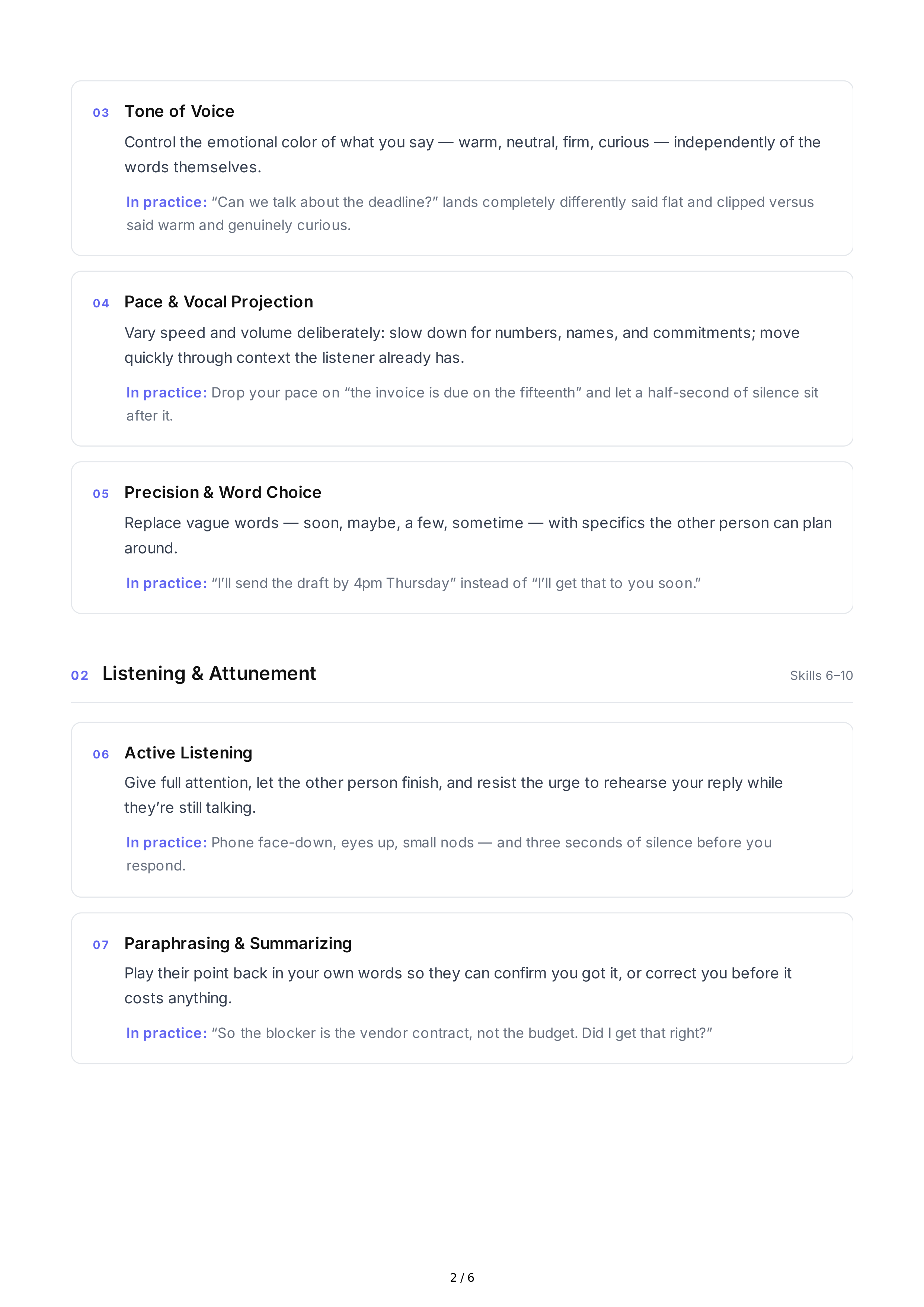
03
Tone
of
Voice
Control
the
emotional
color
of
what
you
say
—
warm
,
neutral
,
firm
,
curious
—
independently
of
the
words
themselves
.
In
practice
:
“
Can
we
talk
about
the
deadline
?”
lands
completely
differently
said
flat
and
clipped
versus
said
warm
and
genuinely
curious
.
04
Pace
&
Vocal
Projection
Vary
speed
and
volume
deliberately
:
slow
down
for
numbers
,
names
,
and
commitments
;
move
quickly
through
context
the
listener
already
has
.
In
practice
:
Drop
your
pace
on
“
the
invoice
is
due
on
the
fifteenth
”
and
let
a
half
-
second
of
silence
sit
after
it
.
05
Precision
&
Word
Choice
Replace
vague
words
—
soon
,
maybe
,
a
few
,
sometime
—
with
specifics
the
other
person
can
plan
around
.
In
practice
:
“
I
’
ll
send
the
draft
by
4
pm
Thursday
”
instead
of
“
I
’
ll
get
that
to
you
soon
.”
02
Listening
&
Attunement
Skills
6–10
06
Active
Listening
Give
full
attention
,
let
the
other
person
finish
,
and
resist
the
urge
to
rehearse
your
reply
while
they
’
re
still
talking
.
In
practice
:
Phone
face
-
down
,
eyes
up
,
small
nods
—
and
three
seconds
of
silence
before
you
respond
.
07
Paraphrasing
&
Summarizing
Play
their
point
back
in
your
own
words
so
they
can
confirm
you
got
it
,
or
correct
you
before
it
costs
anything
.
In
practice
:
“
So
the
blocker
is
the
vendor
contract
,
not
the
budget
.
Did
I
get
that
right
?”
2 / 6
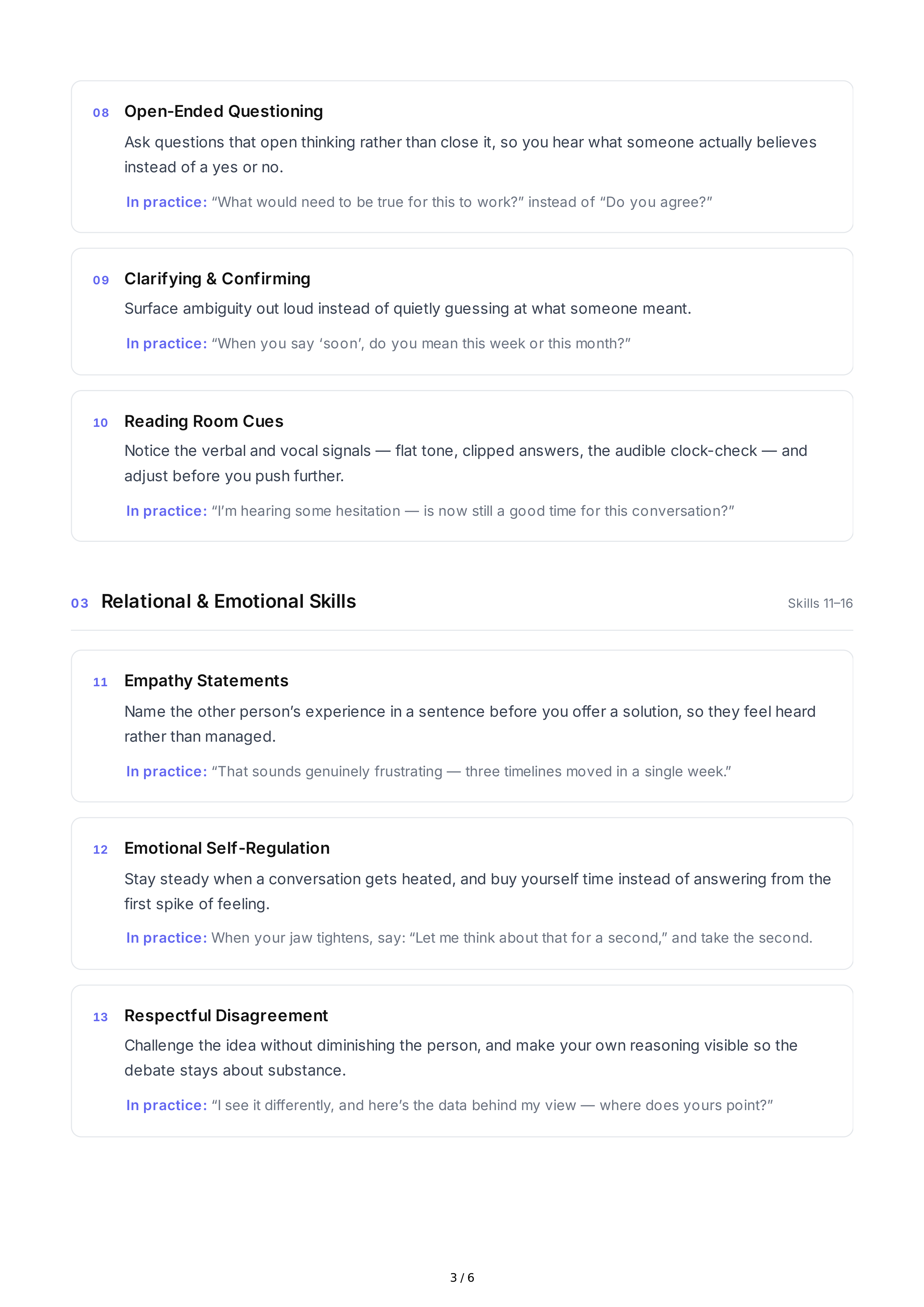
08
Open
-
Ended
Questioning
Ask
questions
that
open
thinking
rather
than
close
it
,
so
you
hear
what
someone
actually
believes
instead
of
a
yes
or
no
.
In
practice
:
“
What
would
need
to
be
true
for
this
to
work
?”
instead
of
“
Do
you
agree
?”
09
Clarifying
&
Confirming
Surface
ambiguity
out
loud
instead
of
quietly
guessing
at
what
someone
meant
.
In
practice
:
“
When
you
say
‘
soon
’,
do
you
mean
this
week
or
this
month
?”
10
Reading
Room
Cues
Notice
the
verbal
and
vocal
signals
—
flat
tone
,
clipped
answers
,
the
audible
clock
-
check
—
and
adjust
before
you
push
further
.
In
practice
:
“
I
’
m
hearing
some
hesitation
—
is
now
still
a
good
time
for
this
conversation
?”
03
Relational
&
Emotional
Skills
Skills
11–16
11
Empathy
Statements
Name
the
other
person
’
s
experience
in
a
sentence
before
you
offer
a
solution
,
so
they
feel
heard
rather
than
managed
.
In
practice
:
“
That
sounds
genuinely
frustrating
—
three
timelines
moved
in
a
single
week
.”
12
Emotional
Self
-
Regulation
Stay
steady
when
a
conversation
gets
heated
,
and
buy
yourself
time
instead
of
answering
from
the
first
spike
of
feeling
.
In
practice
:
When
your
jaw
tightens
,
say
: “
Let
me
think
about
that
for
a
second
,”
and
take
the
second
.
13
Respectful
Disagreement
Challenge
the
idea
without
diminishing
the
person
,
and
make
your
own
reasoning
visible
so
the
debate
stays
about
substance
.
In
practice
:
“
I
see
it
differently
,
and
here
’
s
the
data
behind
my
view
—
where
does
yours
point
?”
3 / 6
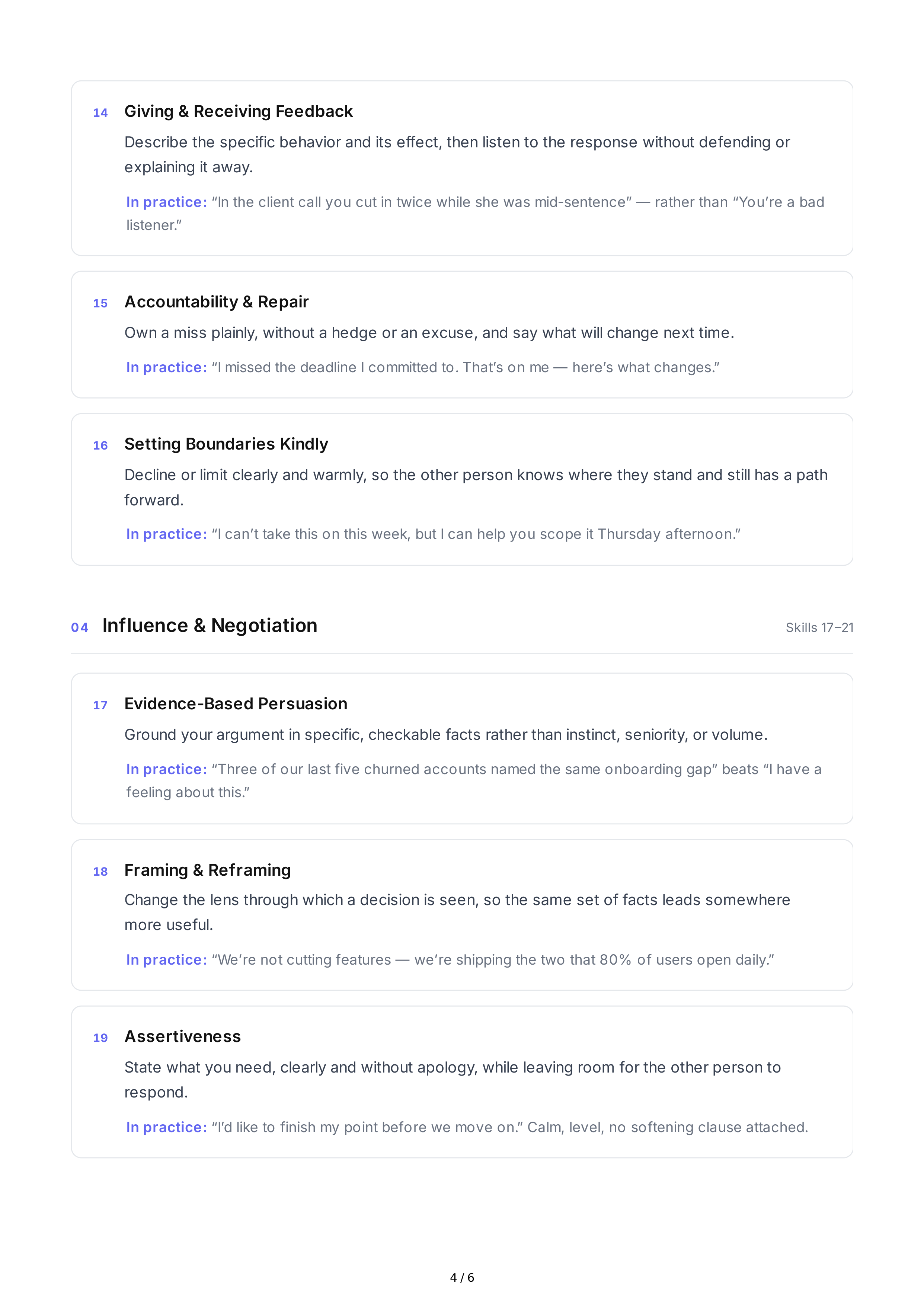
14
Giving
&
Receiving
Feedback
Describe
the
specific
behavior
and
its
effect
,
then
listen
to
the
response
without
defending
or
explaining
it
away
.
In
practice
:
“
In
the
client
call
you
cut
in
twice
while
she
was
mid
-
sentence
” —
rather
than
“
You
’
re
a
bad
listener
.”
15
Accountability
&
Repair
Own
a
miss
plainly
,
without
a
hedge
or
an
excuse
,
and
say
what
will
change
next
time
.
In
practice
:
“
I
missed
the
deadline
I
committed
to
.
That
’
s
on
me
—
here
’
s
what
changes
.”
16
Setting
Boundaries
Kindly
Decline
or
limit
clearly
and
warmly
,
so
the
other
person
knows
where
they
stand
and
still
has
a
path
forward
.
In
practice
:
“
I
can
’
t
take
this
on
this
week
,
but
I
can
help
you
scope
it
Thursday
afternoon
.”
04
Influence
&
Negotiation
Skills
17–21
17
Evidence
-
Based
Persuasion
Ground
your
argument
in
specific
,
checkable
facts
rather
than
instinct
,
seniority
,
or
volume
.
In
practice
:
“
Three
of
our
last
five
churned
accounts
named
the
same
onboarding
gap
”
beats
“
I
have
a
feeling
about
this
.”
18
Framing
&
Reframing
Change
the
lens
through
which
a
decision
is
seen
,
so
the
same
set
of
facts
leads
somewhere
more
useful
.
In
practice
:
“
We
’
re
not
cutting
features
—
we
’
re
shipping
the
two
that
80%
of
users
open
daily
.”
19
Assertiveness
State
what
you
need
,
clearly
and
without
apology
,
while
leaving
room
for
the
other
person
to
respond
.
In
practice
:
“
I
’
d
like
to
finish
my
point
before
we
move
on
.”
Calm
,
level
,
no
softening
clause
attached
.
4 / 6
20
Negotiation
&
Trade
-
offs
Trade
constraints
openly
instead
of
digging
into
positions
,
and
hand
the
other
side
a
real
choice
.
In
practice
:
“
I
can
hit
the
earlier
date
if
we
drop
the
reporting
module
—
your
call
.”
21
Storytelling
Use
a
short
concrete
narrative
with
a
person
,
a
problem
,
and
a
resolution
to
make
an
abstract
point
memorable
.
In
practice
:
“
The
first
customer
signed
because
her
team
stopped
losing
leads
in
the
handoff
—
here
’
s
what
that
looked
like
.”
05
Group
&
Public
Communication
Skills
22–26
22
Facilitation
&
Meeting
Leadership
Keep
a
group
moving
toward
its
decision
,
protect
the
agenda
,
and
park
tangents
without
dismissing
them
.
In
practice
:
“
That
’
s
a
good
thread
—
let
’
s
capture
it
and
finish
the
decision
we
came
here
for
.”
23
Public
Speaking
&
Presentation
Hold
a
room
with
structure
,
deliberate
pauses
,
and
one
clear
through
-
line
instead
of
a
wall
of
slides
.
In
practice
:
Pause
after
the
key
number
,
let
it
land
,
then
explain
it
—
never
talk
over
your
own
headline
.
24
Turn
-
Taking
&
Conversational
Flow
Manage
who
speaks
and
when
,
so
quieter
people
are
brought
in
and
one
voice
doesn
’
t
absorb
the
whole
call
.
In
practice
:
“
Priya
,
I
’
d
like
your
read
on
this
—
you
’
ve
been
quiet
and
you
own
the
risk
.”
25
Cross
-
Cultural
Communication
Adapt
directness
,
formality
,
and
pace
to
the
norms
of
the
people
you
’
re
speaking
with
,
not
just
your
own
default
.
In
practice
:
“
That
won
’
t
work
”
reads
as
blunt
in
a
Tokyo
meeting
and
entirely
normal
in
a
New
York
one
—
calibrate
accordingly
.
5 / 6

26
Recognition
&
Encouragement
Name
a
specific
contribution
out
loud
and
on
time
,
so
good
work
is
visible
to
the
person
who
did
it
.
In
practice
:
“
The
way
you
handled
that
escalation
was
excellent
—
the
client
emailed
to
say
so
.”
6 / 6
