01–20
01–05
Storytelling
Interpersonal
Skills
T HE
SK I LLS
AT
A
G LAN CE
The
full
list
,
grouped
into
four
clusters
.
Everything
below
this
page
expands
each
one
.
C L US T ER
1 —
L IS T EN IN G
01
Narrative
Empathy
02
Detail
Listening
03
Silence
Tolerance
04
Emotional
Contagion
Awareness
05
Boundary
Reading
C L US T ER
2 —
T EL L IN G
YO UR
O WN
01
Concrete
Detail
Selection
02
Stakes
Framing
03
Emotional
Honesty
04
Concise
Arc
05
Proportionate
Disclosure
C L US T ER
3 —
M AKIN G
IT
L AN D
01
Audience
Attunement
02
Metaphor
Translation
03
Pacing
and
Pause
04
Ending
Without
a
Moral
05
Callback
C L US T ER
4 —
R EL AT IN G
01
Invitation
Questions
02
Consent
and
Attribution
03
Story
-
First
Feedback
04
Story
Recall
05
Narrative
Repair
CLUST E R
1 —
LI ST E N I N G
You
cannot
tell
a
story
that
connects
unless
you
can
hear
one
.
These
five
skills
govern
intake
:
what
you
notice
,
what
you
leave
alone
,
and
how
you
hold
a
room
while
someone
else
is
talking
.
01
Narrative
Empathy
Hearing
the
story
underneath
the
report
.
Most
people
hand
you
facts
first
—
the
ticket
,
the
delay
,
the
number
—
and
the
actual
story
is
what
those
facts
cost
them
.
IN
PRACT ICE
Ask
“
what
happened
next
?”
instead
of
offering
a
solution
.
The
solution
is
usually
not
what
the
first
three
minutes
are
for
.
S O UNDS
LIKE
“
You
'
ve
told
me
what
broke
.
Walk
me
through
the
ten
minutes
before
it
broke
.”
1 / 8
06–10
02
Detail
Listening
Noticing
which
specifics
a
person
repeats
,
softens
,
or
skips
past
.
Repetition
is
a
marker
:
the
detail
someone
returns
to
three
times
is
usually
the
part
that
still
hurts
or
still
matters
.
IN
PRACT ICE
Track
the
nouns
,
not
the
adjectives
.
If
someone
says
“
the
Tuesday
meeting
”
three
times
in
one
account
,
Tuesday
is
the
story
.
S O UNDS
LIKE
“
You
'
ve
mentioned
Tuesday
twice
.
Start
there
—
what
was
different
about
Tuesday
?”
03
Silence
Tolerance
Letting
a
pause
sit
long
enough
for
the
other
person
to
finish
the
thought
they
were
building
.
Most
people
fill
silence
at
two
seconds
;
most
important
sentences
arrive
at
four
or
five
.
IN
PRACT ICE
Count
to
five
before
you
speak
into
a
pause
.
Do
not
fill
it
with
a
summary
of
what
you
just
heard
—
that
closes
the
door
rather
than
holding
it
open
.
S O UNDS
LIKE
Nothing
.
A
nod
,
and
waiting
.
The
sentence
usually
completes
itself
.
04
Emotional
Contagion
Awareness
Recognising
that
your
own
state
is
writing
the
story
before
you
open
your
mouth
.
Anxiety
produces
urgency
;
defensiveness
produces
blame
;
both
get
absorbed
by
the
room
within
about
thirty
seconds
.
IN
PRACT ICE
Check
your
own
tempo
before
a
tense
conversation
and
deliberately
set
it
lower
than
the
room
'
s
,
rather
than
matching
it
.
S O UNDS
LIKE
“
I
'
m
going
to
slow
down
for
a
second
,
because
I
don
'
t
want
to
give
you
a
version
of
this
that
'
s
coloured
by
how
the
morning
went
.”
05
Boundary
Reading
Telling
the
difference
between
a
story
being
offered
and
a
story
being
protected
.
Someone
can
mention
a
hard
thing
without
inviting
a
follow
-
up
question
,
and
reading
that
correctly
is
what
keeps
them
talking
later
.
IN
PRACT ICE
Offer
the
exit
before
you
offer
the
question
.
People
almost
always
continue
when
they
know
they
can
stop
.
S O UNDS
LIKE
“
You
don
'
t
have
to
get
into
it
—
but
I
'
m
here
if
you
want
to
.”
CLUST E R
2 —
T E LLI N G
YO UR
O WN
2 / 8
The
craft
skills
.
These
are
what
separate
a
story
that
lands
from
a
story
that
merely
takes
up
time
—
detail
,
stakes
,
honesty
,
brevity
,
and
knowing
how
much
of
yourself
to
put
on
the
table
.
06
Concrete
Detail
Selection
Choosing
the
single
image
that
makes
an
abstract
point
real
,
and
cutting
everything
around
it
.
One
specific
detail
outperforms
three
sentences
of
summary
every
time
.
IN
PRACT ICE
Replace
every
adjective
with
a
noun
you
could
photograph
. “
Our
data
was
messy
”
becomes
something
with
a
number
and
an
owner
in
it
.
S O UNDS
LIKE
“
The
asset
register
was
a
spreadsheet
with
4,100
rows
and
no
named
owner
.”
07
Stakes
Framing
Naming
what
was
at
risk
early
,
before
the
turn
.
Listeners
lean
in
for
consequence
,
not
chronology
—
if
nothing
can
be
lost
,
the
account
is
a
status
update
,
not
a
story
.
IN
PRACT ICE
State
the
consequence
in
the
first
two
sentences
,
in
people
or
numbers
rather
than
in
principle
.
S O UNDS
LIKE
“
If
we
'
d
shipped
that
on
the
Friday
,
we
'
d
have
told
12,000
customers
something
untrue
.”
08
Emotional
Honesty
Saying
the
true
feeling
rather
than
the
acceptable
one
.
Polished
emotions
are
detectable
and
they
cost
you
credibility
with
the
person
listening
.
IN
PRACT ICE
Name
the
less
flattering
version
once
,
plainly
,
and
move
on
.
Do
not
perform
it
—
a
single
accurate
sentence
is
enough
.
S O UNDS
LIKE
“
I
was
embarrassed
,
not
frustrated
.
I
said
frustrated
for
two
weeks
before
I
worked
that
out
.”
09
Concise
Arc
Delivering
a
complete
story
—
setup
,
turn
,
resolution
—
inside
about
ninety
seconds
.
Length
is
the
most
common
reason
a
good
story
fails
:
the
audience
solved
it
before
you
finished
it
.
IN
PRACT ICE
Three
beats
,
three
sentences
.
If
it
doesn
'
t
fit
,
it
'
s
two
stories
and
you
should
tell
the
more
useful
one
.
S O UNDS
LIKE
“
The
plan
was
to
migrate
overnight
.
The
certificate
expired
at
2
am
.
We
now
run
the
expiry
check
weekly
.”
3 / 8
11–15
10
Proportionate
Disclosure
Matching
how
much
of
yourself
you
share
to
the
age
and
depth
of
the
relationship
.
Trust
built
too
fast
reads
as
performance
,
and
it
makes
the
other
person
feel
they
owe
you
something
.
IN
PRACT ICE
Have
a
two
-
line
version
and
a
full
version
of
every
personal
story
you
tell
at
work
,
and
choose
deliberately
between
them
.
S O UNDS
LIKE
The
two
-
line
version
in
a
first
conversation
;
the
full
version
six
months
in
,
when
it
can
be
received
rather
than
just
delivered
.
CLUST E R
3 —
M AK I N G
I T
LAN D
Delivery
skills
with
a
relational
purpose
.
The
question
is
not
“
did
I
tell
it
well
?”
but
“
did
it
arrive
in
the
listener
'
s
world
,
in
their
language
,
at
their
pace
?”
11
Audience
Attunement
Choosing
the
story
the
room
can
see
itself
in
.
The
same
lesson
needs
a
different
door
depending
on
who
is
standing
in
front
of
it
.
IN
PRACT ICE
Before
speaking
,
answer
one
question
:
what
has
this
specific
group
personally
lost
or
gained
this
quarter
?
Lead
with
that
.
S O UNDS
LIKE
The
compliance
consequence
for
the
finance
team
;
the
3
am
pager
for
the
engineers
.
One
lesson
,
two
openings
.
12
Metaphor
Translation
Re
-
describing
an
idea
in
the
listener
'
s
own
vocabulary
rather
than
your
own
.
A
metaphor
that
comes
from
their
domain
removes
a
translation
step
;
a
metaphor
from
yours
adds
one
.
IN
PRACT ICE
Borrow
the
nouns
from
their
last
two
sentences
.
If
they
said
“
pipeline
,”
stop
saying
“
funnel
.”
S O UNDS
LIKE
“
Think
of
the
review
step
as
a
traffic
light
,
not
a
gate
—
it
slows
the
flow
,
it
doesn
'
t
stop
it
.”
4 / 8
16–20
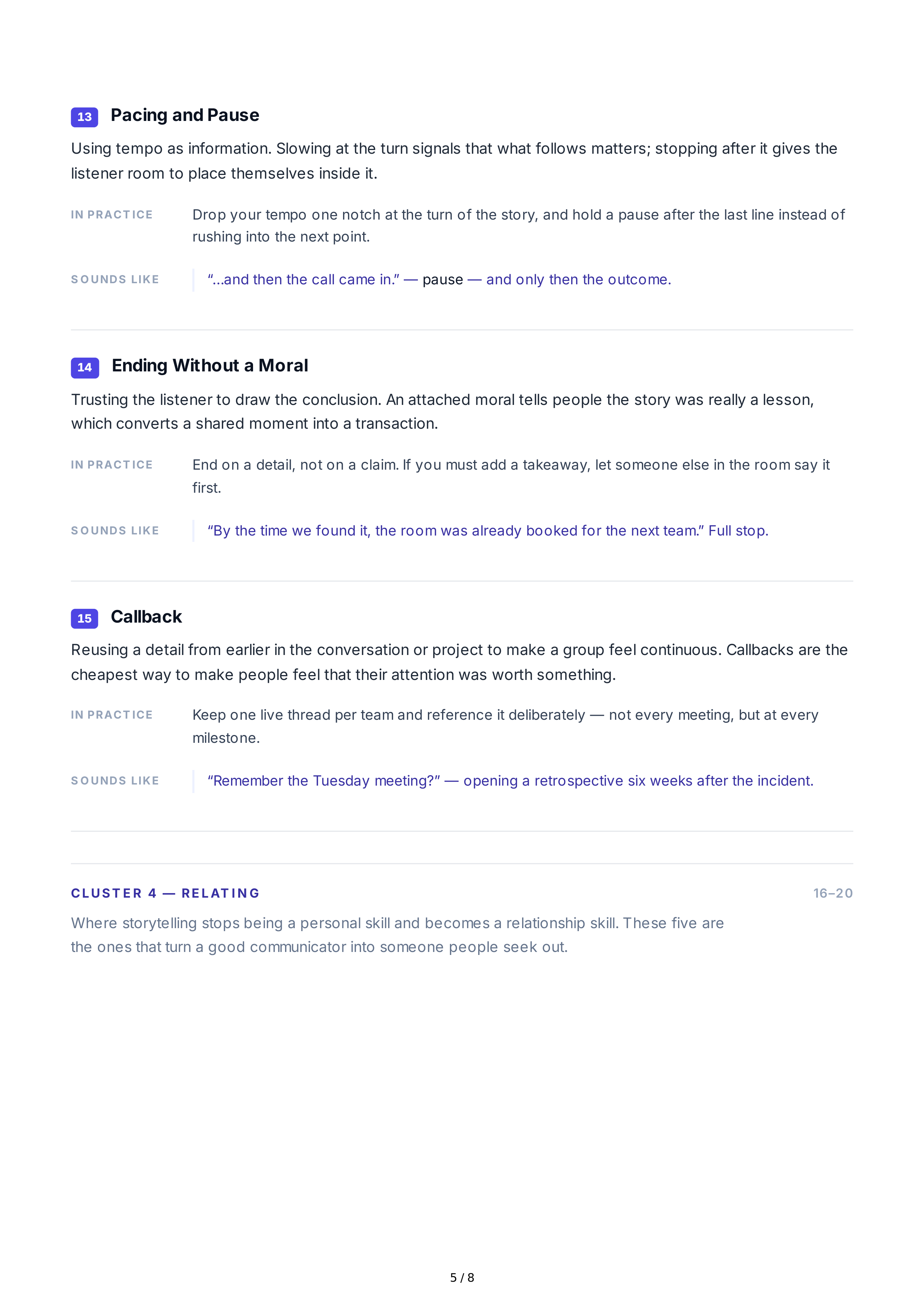
13
Pacing
and
Pause
Using
tempo
as
information
.
Slowing
at
the
turn
signals
that
what
follows
matters
;
stopping
after
it
gives
the
listener
room
to
place
themselves
inside
it
.
IN
PRACT ICE
Drop
your
tempo
one
notch
at
the
turn
of
the
story
,
and
hold
a
pause
after
the
last
line
instead
of
rushing
into
the
next
point
.
S O UNDS
LIKE
“…
and
then
the
call
came
in
.” —
pause
—
and
only
then
the
outcome
.
14
Ending
Without
a
Moral
Trusting
the
listener
to
draw
the
conclusion
.
An
attached
moral
tells
people
the
story
was
really
a
lesson
,
which
converts
a
shared
moment
into
a
transaction
.
IN
PRACT ICE
End
on
a
detail
,
not
on
a
claim
.
If
you
must
add
a
takeaway
,
let
someone
else
in
the
room
say
it
first
.
S O UNDS
LIKE
“
By
the
time
we
found
it
,
the
room
was
already
booked
for
the
next
team
.”
Full
stop
.
15
Callback
Reusing
a
detail
from
earlier
in
the
conversation
or
project
to
make
a
group
feel
continuous
.
Callbacks
are
the
cheapest
way
to
make
people
feel
that
their
attention
was
worth
something
.
IN
PRACT ICE
Keep
one
live
thread
per
team
and
reference
it
deliberately
—
not
every
meeting
,
but
at
every
milestone
.
S O UNDS
LIKE
“
Remember
the
Tuesday
meeting
?” —
opening
a
retrospective
six
weeks
after
the
incident
.
CLUST E R
4 —
RE LAT I N G
Where
storytelling
stops
being
a
personal
skill
and
becomes
a
relationship
skill
.
These
five
are
the
ones
that
turn
a
good
communicator
into
someone
people
seek
out
.
5 / 8
16
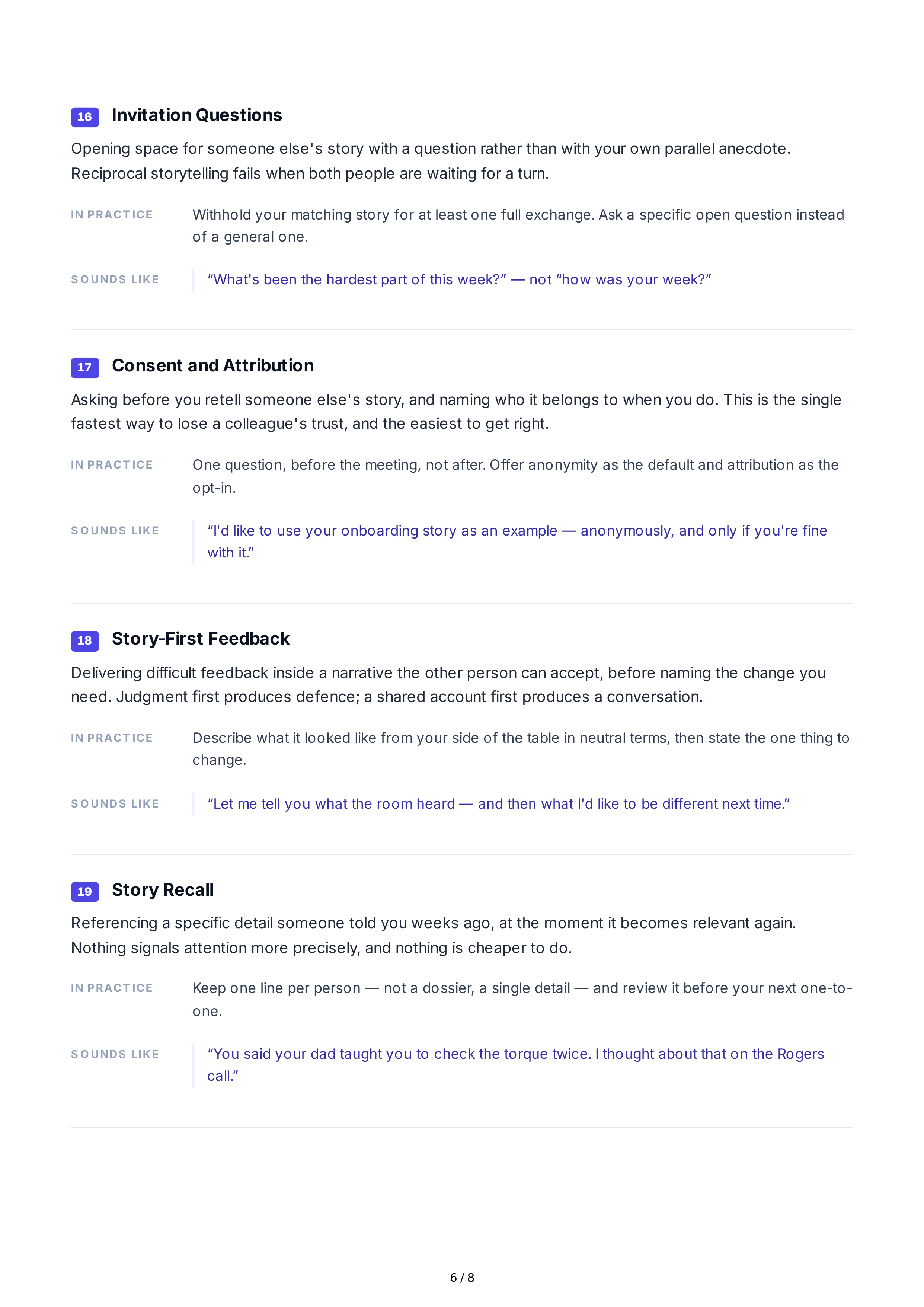
Invitation
Questions
Opening
space
for
someone
else
'
s
story
with
a
question
rather
than
with
your
own
parallel
anecdote
.
Reciprocal
storytelling
fails
when
both
people
are
waiting
for
a
turn
.
IN
PRACT ICE
Withhold
your
matching
story
for
at
least
one
full
exchange
.
Ask
a
specific
open
question
instead
of
a
general
one
.
S O UNDS
LIKE
“
What
'
s
been
the
hardest
part
of
this
week
?” —
not
“
how
was
your
week
?”
17
Consent
and
Attribution
Asking
before
you
retell
someone
else
'
s
story
,
and
naming
who
it
belongs
to
when
you
do
.
This
is
the
single
fastest
way
to
lose
a
colleague
'
s
trust
,
and
the
easiest
to
get
right
.
IN
PRACT ICE
One
question
,
before
the
meeting
,
not
after
.
Offer
anonymity
as
the
default
and
attribution
as
the
opt
-
in
.
S O UNDS
LIKE
“
I
'
d
like
to
use
your
onboarding
story
as
an
example
—
anonymously
,
and
only
if
you
'
re
fine
with
it
.”
18
Story
-
First
Feedback
Delivering
difficult
feedback
inside
a
narrative
the
other
person
can
accept
,
before
naming
the
change
you
need
.
Judgment
first
produces
defence
;
a
shared
account
first
produces
a
conversation
.
IN
PRACT ICE
Describe
what
it
looked
like
from
your
side
of
the
table
in
neutral
terms
,
then
state
the
one
thing
to
change
.
S O UNDS
LIKE
“
Let
me
tell
you
what
the
room
heard
—
and
then
what
I
'
d
like
to
be
different
next
time
.”
19
Story
Recall
Referencing
a
specific
detail
someone
told
you
weeks
ago
,
at
the
moment
it
becomes
relevant
again
.
Nothing
signals
attention
more
precisely
,
and
nothing
is
cheaper
to
do
.
IN
PRACT ICE
Keep
one
line
per
person
—
not
a
dossier
,
a
single
detail
—
and
review
it
before
your
next
one
-
to
-
one
.
S O UNDS
LIKE
“
You
said
your
dad
taught
you
to
check
the
torque
twice
.
I
thought
about
that
on
the
Rogers
call
.”
6 / 8
ALL
20
20
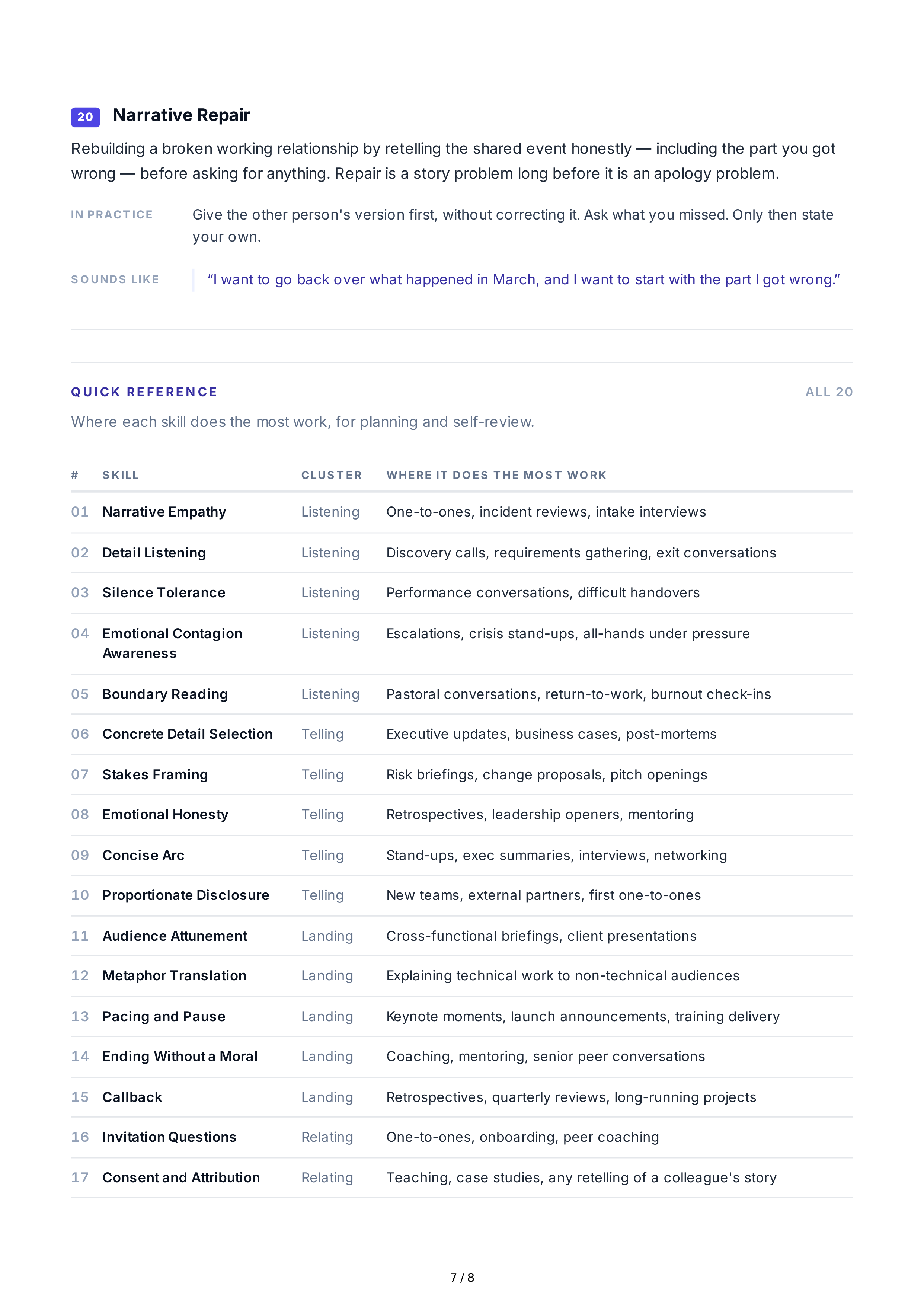
Narrative
Repair
Rebuilding
a
broken
working
relationship
by
retelling
the
shared
event
honestly
—
including
the
part
you
got
wrong
—
before
asking
for
anything
.
Repair
is
a
story
problem
long
before
it
is
an
apology
problem
.
IN
PRACT ICE
Give
the
other
person
'
s
version
first
,
without
correcting
it
.
Ask
what
you
missed
.
Only
then
state
your
own
.
S O UNDS
LIKE
“
I
want
to
go
back
over
what
happened
in
March
,
and
I
want
to
start
with
the
part
I
got
wrong
.”
Q UI CK
RE FE RE N CE
Where
each
skill
does
the
most
work
,
for
planning
and
self
-
review
.
#
S KILL
CLUS T ER
WHERE
IT
DO ES
T HE
MO S T
WO RK
01
Narrative
Empathy
Listening
One
-
to
-
ones
,
incident
reviews
,
intake
interviews
02
Detail
Listening
Listening
Discovery
calls
,
requirements
gathering
,
exit
conversations
03
Silence
Tolerance
Listening
Performance
conversations
,
difficult
handovers
04
Emotional
Contagion
Awareness
Listening
Escalations
,
crisis
stand
-
ups
,
all
-
hands
under
pressure
05
Boundary
Reading
Listening
Pastoral
conversations
,
return
-
to
-
work
,
burnout
check
-
ins
06
Concrete
Detail
Selection
Telling
Executive
updates
,
business
cases
,
post
-
mortems
07
Stakes
Framing
Telling
Risk
briefings
,
change
proposals
,
pitch
openings
08
Emotional
Honesty
Telling
Retrospectives
,
leadership
openers
,
mentoring
09
Concise
Arc
Telling
Stand
-
ups
,
exec
summaries
,
interviews
,
networking
10
Proportionate
Disclosure
Telling
New
teams
,
external
partners
,
first
one
-
to
-
ones
11
Audience
Attunement
Landing
Cross
-
functional
briefings
,
client
presentations
12
Metaphor
Translation
Landing
Explaining
technical
work
to
non
-
technical
audiences
13
Pacing
and
Pause
Landing
Keynote
moments
,
launch
announcements
,
training
delivery
14
Ending
Without
a
Moral
Landing
Coaching
,
mentoring
,
senior
peer
conversations
15
Callback
Landing
Retrospectives
,
quarterly
reviews
,
long
-
running
projects
16
Invitation
Questions
Relating
One
-
to
-
ones
,
onboarding
,
peer
coaching
17
Consent
and
Attribution
Relating
Teaching
,
case
studies
,
any
retelling
of
a
colleague
'
s
story
7 / 8

#
S KILL
CLUS T ER
WHERE
IT
DO ES
T HE
MO S T
WO RK
18
Story
-
First
Feedback
Relating
Line
management
,
peer
review
,
design
critique
19
Story
Recall
Relating
Ongoing
one
-
to
-
ones
,
mentoring
relationships
,
retention
20
Narrative
Repair
Relating
Conflict
resolution
,
post
-
incident
trust
rebuild
,
mediation
8 / 8
