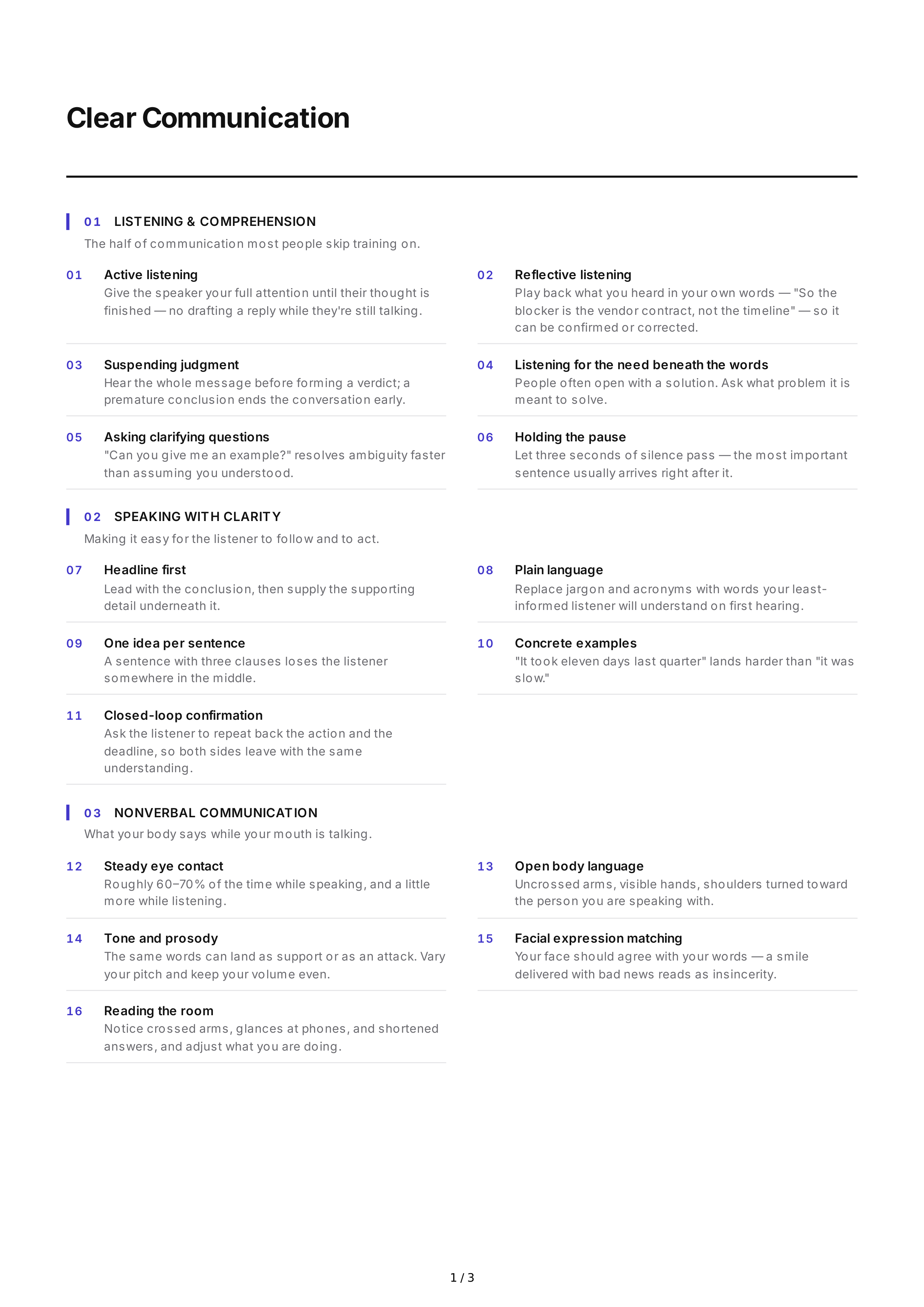
Clear
Communication
0 1
LISTENING
&
COMPREHENSION
The
half
of
communication
most
people
skip
training
on
.
01
Active
listening
Give
the
speaker
your
full
attention
until
their
thought
is
finished
—
no
drafting
a
reply
while
they
'
re
still
talking
.
02
Reflective
listening
Play
back
what
you
heard
in
your
own
words
— "
So
the
blocker
is
the
vendor
contract
,
not
the
timeline
" —
so
it
can
be
confirmed
or
corrected
.
03
Suspending
judgment
Hear
the
whole
message
before
forming
a
verdict
;
a
premature
conclusion
ends
the
conversation
early
.
04
Listening
for
the
need
beneath
the
words
People
often
open
with
a
solution
.
Ask
what
problem
it
is
meant
to
solve
.
05
Asking
clarifying
questions
"
Can
you
give
me
an
example
?"
resolves
ambiguity
faster
than
assuming
you
understood
.
06
Holding
the
pause
Let
three
seconds
of
silence
pass
—
the
most
important
sentence
usually
arrives
right
after
it
.
0 2
SPEAKING
WITH
CLARITY
Making
it
easy
for
the
listener
to
follow
and
to
act
.
07
Headline
first
Lead
with
the
conclusion
,
then
supply
the
supporting
detail
underneath
it
.
08
Plain
language
Replace
jargon
and
acronyms
with
words
your
least
-
informed
listener
will
understand
on
first
hearing
.
09
One
idea
per
sentence
A
sentence
with
three
clauses
loses
the
listener
somewhere
in
the
middle
.
10
Concrete
examples
"
It
took
eleven
days
last
quarter
"
lands
harder
than
"
it
was
slow
."
11
Closed
-
loop
confirmation
Ask
the
listener
to
repeat
back
the
action
and
the
deadline
,
so
both
sides
leave
with
the
same
understanding
.
0 3
NONVERBAL
COMMUNICATION
What
your
body
says
while
your
mouth
is
talking
.
12
Steady
eye
contact
Roughly
60–70%
of
the
time
while
speaking
,
and
a
little
more
while
listening
.
13
Open
body
language
Uncrossed
arms
,
visible
hands
,
shoulders
turned
toward
the
person
you
are
speaking
with
.
14
Tone
and
prosody
The
same
words
can
land
as
support
or
as
an
attack
.
Vary
your
pitch
and
keep
your
volume
even
.
15
Facial
expression
matching
Your
face
should
agree
with
your
words
—
a
smile
delivered
with
bad
news
reads
as
insincerity
.
16
Reading
the
room
Notice
crossed
arms
,
glances
at
phones
,
and
shortened
answers
,
and
adjust
what
you
are
doing
.
1 / 3
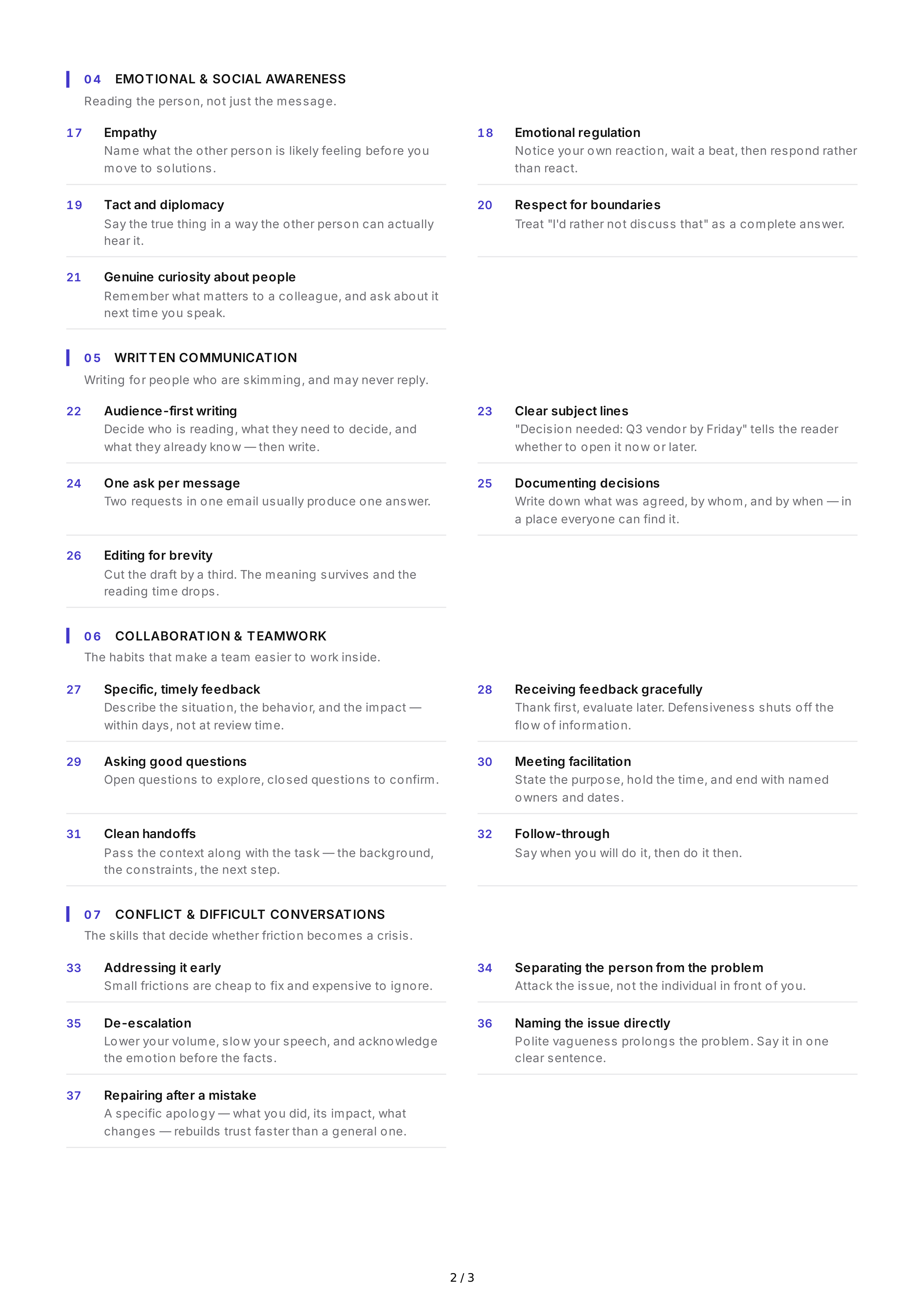
0 4
EMOTIONAL
&
SOCIAL
AWARENESS
Reading
the
person
,
not
just
the
message
.
17
Empathy
Name
what
the
other
person
is
likely
feeling
before
you
move
to
solutions
.
18
Emotional
regulation
Notice
your
own
reaction
,
wait
a
beat
,
then
respond
rather
than
react
.
19
Tact
and
diplomacy
Say
the
true
thing
in
a
way
the
other
person
can
actually
hear
it
.
20
Respect
for
boundaries
Treat
"
I
'
d
rather
not
discuss
that
"
as
a
complete
answer
.
21
Genuine
curiosity
about
people
Remember
what
matters
to
a
colleague
,
and
ask
about
it
next
time
you
speak
.
0 5
WRITTEN
COMMUNICATION
Writing
for
people
who
are
skimming
,
and
may
never
reply
.
22
Audience
-
first
writing
Decide
who
is
reading
,
what
they
need
to
decide
,
and
what
they
already
know
—
then
write
.
23
Clear
subject
lines
"
Decision
needed
:
Q
3
vendor
by
Friday
"
tells
the
reader
whether
to
open
it
now
or
later
.
24
One
ask
per
message
Two
requests
in
one
email
usually
produce
one
answer
.
25
Documenting
decisions
Write
down
what
was
agreed
,
by
whom
,
and
by
when
—
in
a
place
everyone
can
find
it
.
26
Editing
for
brevity
Cut
the
draft
by
a
third
.
The
meaning
survives
and
the
reading
time
drops
.
0 6
COLLABORATION
&
TEAMWORK
The
habits
that
make
a
team
easier
to
work
inside
.
27
Specific
,
timely
feedback
Describe
the
situation
,
the
behavior
,
and
the
impact
—
within
days
,
not
at
review
time
.
28
Receiving
feedback
gracefully
Thank
first
,
evaluate
later
.
Defensiveness
shuts
off
the
flow
of
information
.
29
Asking
good
questions
Open
questions
to
explore
,
closed
questions
to
confirm
.
30
Meeting
facilitation
State
the
purpose
,
hold
the
time
,
and
end
with
named
owners
and
dates
.
31
Clean
handoffs
Pass
the
context
along
with
the
task
—
the
background
,
the
constraints
,
the
next
step
.
32
Follow
-
through
Say
when
you
will
do
it
,
then
do
it
then
.
0 7
CONFLICT
&
DIFFICULT
CONVERSATIONS
The
skills
that
decide
whether
friction
becomes
a
crisis
.
33
Addressing
it
early
Small
frictions
are
cheap
to
fix
and
expensive
to
ignore
.
34
Separating
the
person
from
the
problem
Attack
the
issue
,
not
the
individual
in
front
of
you
.
35
De
-
escalation
Lower
your
volume
,
slow
your
speech
,
and
acknowledge
the
emotion
before
the
facts
.
36
Naming
the
issue
directly
Polite
vagueness
prolongs
the
problem
.
Say
it
in
one
clear
sentence
.
37
Repairing
after
a
mistake
A
specific
apology
—
what
you
did
,
its
impact
,
what
changes
—
rebuilds
trust
faster
than
a
general
one
.
2 / 3
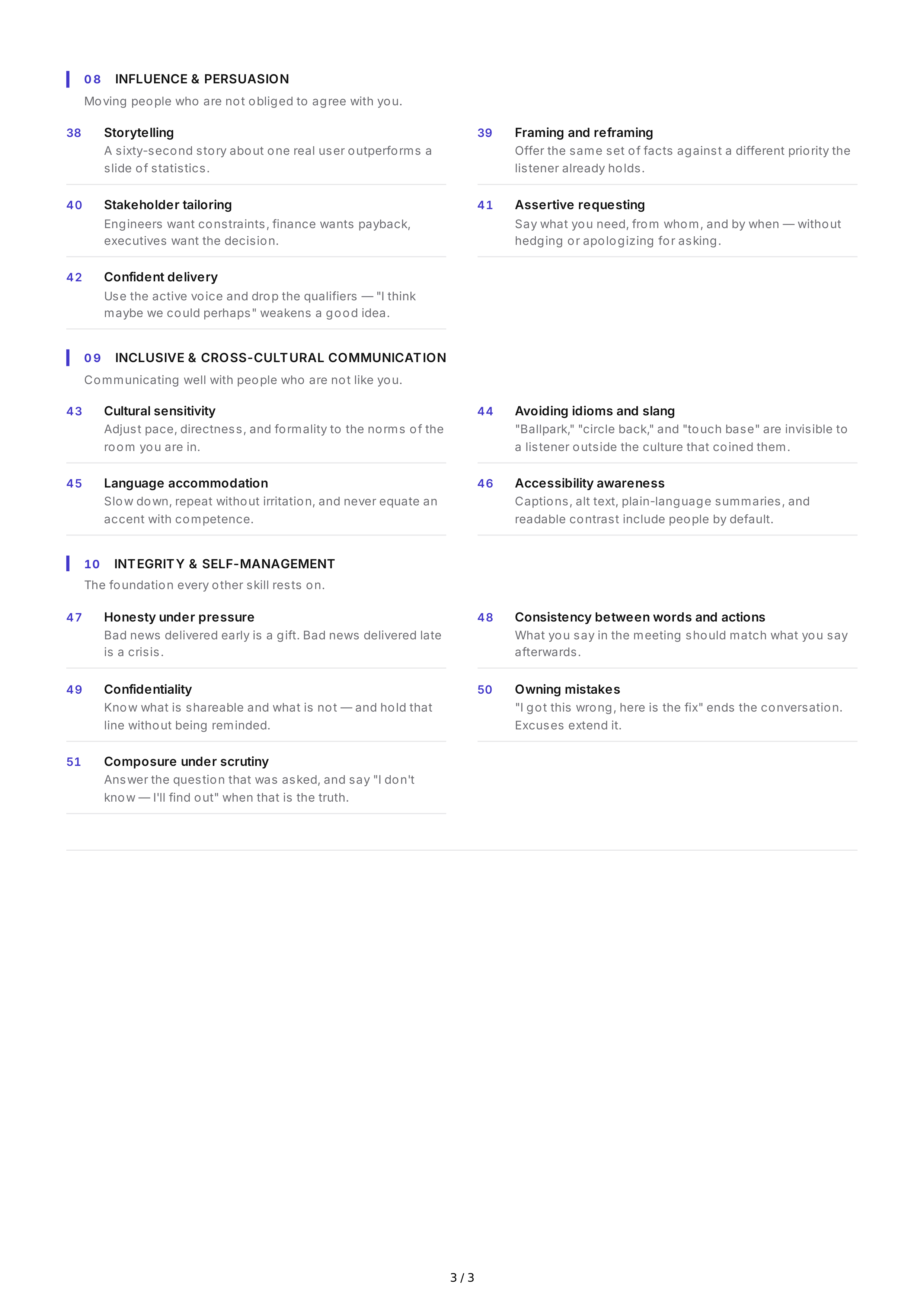
0 8
INFLUENCE
&
PERSUASION
Moving
people
who
are
not
obliged
to
agree
with
you
.
38
Storytelling
A
sixty
-
second
story
about
one
real
user
outperforms
a
slide
of
statistics
.
39
Framing
and
reframing
Offer
the
same
set
of
facts
against
a
different
priority
the
listener
already
holds
.
40
Stakeholder
tailoring
Engineers
want
constraints
,
finance
wants
payback
,
executives
want
the
decision
.
41
Assertive
requesting
Say
what
you
need
,
from
whom
,
and
by
when
—
without
hedging
or
apologizing
for
asking
.
42
Confident
delivery
Use
the
active
voice
and
drop
the
qualifiers
— "
I
think
maybe
we
could
perhaps
"
weakens
a
good
idea
.
0 9
INCLUSIVE
&
CROSS
-
CULTURAL
COMMUNICATION
Communicating
well
with
people
who
are
not
like
you
.
43
Cultural
sensitivity
Adjust
pace
,
directness
,
and
formality
to
the
norms
of
the
room
you
are
in
.
44
Avoiding
idioms
and
slang
"
Ballpark
," "
circle
back
,"
and
"
touch
base
"
are
invisible
to
a
listener
outside
the
culture
that
coined
them
.
45
Language
accommodation
Slow
down
,
repeat
without
irritation
,
and
never
equate
an
accent
with
competence
.
46
Accessibility
awareness
Captions
,
alt
text
,
plain
-
language
summaries
,
and
readable
contrast
include
people
by
default
.
10
INTEGRITY
&
SELF
-
MANAGEMENT
The
foundation
every
other
skill
rests
on
.
47
Honesty
under
pressure
Bad
news
delivered
early
is
a
gift
.
Bad
news
delivered
late
is
a
crisis
.
48
Consistency
between
words
and
actions
What
you
say
in
the
meeting
should
match
what
you
say
afterwards
.
49
Confidentiality
Know
what
is
shareable
and
what
is
not
—
and
hold
that
line
without
being
reminded
.
50
Owning
mistakes
"
I
got
this
wrong
,
here
is
the
fix
"
ends
the
conversation
.
Excuses
extend
it
.
51
Composure
under
scrutiny
Answer
the
question
that
was
asked
,
and
say
"
I
don
'
t
know
—
I
'
ll
find
out
"
when
that
is
the
truth
.
3 / 3