
Cm to Km & Km to Cm Converter
Easily convert between centimeters and kilometers & kilometers to centimeters with Examples.com's accurate and instant measurement unit length conversion tool. Input your value for swift, precise results.
| Centimeter | Kilometer |
|---|---|
| — | — |
| Kilometer | Centimeter |
|---|---|
| — | — |
Length Converters to Centimeter (cm)
Length Converters to Kilometer (km)
How to Convert Centimeters to Kilometers
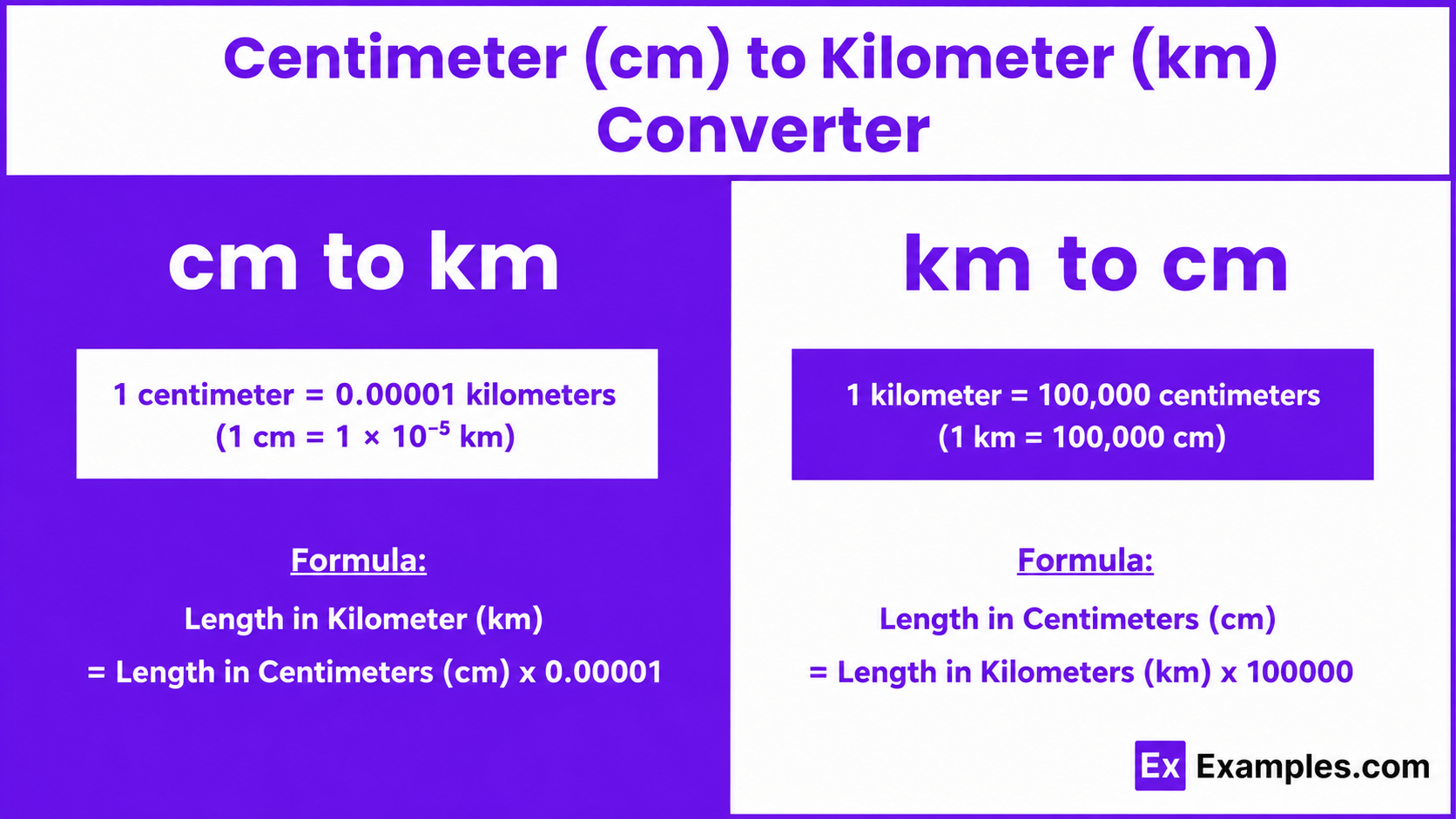
centimeter = 0.00001 kilometers
Start with Your Number in Centimeters
Think of a number of centimeters you want to convert.
1 cm = 0.00001 km
1 km = 100000 cm
Example: convert 600000 cm to km:
600000 cm = 600000 × 0.00001 km = 6 km
How to Convert Kilometers to Centimeters
1 kilometer (1 km) = 100000 centimeters
Start with Your Number in Kilometers
1 km = 100000 cm
1 cm = 0.00001 km
Example: convert 6 kilometers to cm:
6 kilometers = 6 × 100000 cm = 600000 cm
Centimeters to Kilometers Conversion Table
| Centimeters (cm) | Kilometers (km) |
|---|---|
| 1 cm | 0.00001 km |
| 10 cm | 0.0001 km |
| 100 cm | 0.001 km |
| 500 cm | 0.005 km |
| 1,000 cm | 0.01 km |
| 5,000 cm | 0.05 km |
| 10,000 cm | 0.1 km |
| 50,000 cm | 0.5 km |
| 100,000 cm | 1 km |
| 500,000 cm | 5 km |
| 1,000,000 cm | 10 km |
| 5,000,000 cm | 50 km |
| 10,000,000 cm | 100 km |
Kilometers to Centimeters Conversion Table
| Kilometers (km) | Centimeters (cm) |
|---|---|
| 0.00001 km | 1 cm |
| 0.0001 km | 10 cm |
| 0.001 km | 100 cm |
| 0.01 km | 1,000 cm |
| 0.1 km | 10,000 cm |
| 1 km | 100,000 cm |
| 2 km | 200,000 cm |
| 5 km | 500,000 cm |
| 10 km | 1,000,000 cm |
| 50 km | 5,000,000 cm |
| 100 km | 10,000,000 cm |
Differences Between Centimeter and Kilometer
| Aspect | Centimeter (cm) | Kilometer (km) |
|---|---|---|
| Equivalent | One centimeter is equal to 0.00001 kilometers. | One kilometer is equal to 100,000 centimeters. |
| Part of | One centimeter is 1/100th of a meter. | One kilometer is 1,000 meters. |
| Typical Use | Centimeter is used for small everyday measurements like body height, paper, or furniture. | Kilometer is used for long distances like travel routes, road signs, and geography. |
| Measurement System | Belongs to the metric system. | Belongs to the metric system. |
| Scale | A base metric unit for short lengths. | A metric unit 100,000 times larger than the centimeter. |
Solved Examples on Centimeters to Kilometers and Kilometers to Centimeters Conversion
1. Converting Centimeters to Kilometers
- Example 1: Convert 250,000 cm to km. 250,000 cm=250,000×0.00001 km=2.5 km
- Example 2: Convert 1,500,000 cm to km. 1,500,000 cm=1,500,000×0.00001 km=15 km
- Example 3: Convert 75,000 cm to km. 75,000 cm=75,000×0.00001 km=0.75 km
2. Converting Kilometers to Centimeters
- Example 1: Convert 3 km to centimeters. 3 km=3×100,000 cm=300,000 cm
- Example 2: Convert 7.5 km to centimeters. 7.5 km=7.5×100,000 cm=750,000 cm
- Example 3: Convert 0.25 km to centimeters. 0.25 km=0.25×100,000 cm=25,000 cm
1. Why do we need to convert centimeters to kilometers and vice versa?
Centimeters and kilometers sit at opposite ends of the length scale, so converting between them helps us switch smoothly between small, precise measurements and large-scale distances, whether we’re comparing object sizes to travel distances or working across scientific and everyday contexts.
2. How do I convert centimeters to kilometers?
To convert centimeters to kilometers, multiply the number of centimeters by 0.00001, or equivalently, divide it by 100,000. For example, if you have 250,000 centimeters, multiply 250,000 by 0.00001 to get 2.5 kilometers.
3. What about converting kilometers to centimeters?
Converting kilometers to centimeters is just as straightforward. You multiply the number of kilometers by 100,000. So, if you have 3 kilometers, multiply 3 by 100,000 to get 300,000 centimeters.
4. Why is it important to know both units of measurement?
Understanding units of measurement for both centimeters and kilometers gives you flexibility across scales. Centimeters are practical for everyday objects, while kilometers are essential for describing distances between places. Being comfortable converting between the two helps with everything from DIY projects to trip planning.
5. Can I use online converters for accurate conversions?
Absolutely! There are numerous online tools and apps available that can quickly and accurately convert centimeters to kilometers and vice versa. These tools are especially handy when working with very large or very small values, where manual calculation is more prone to error.
6. Are there any common examples I can use to visualize centimeters and kilometers?
Yes, everyday comparisons can help you visualize the scale difference. For example, a standard pencil is about 17.5 centimeters long, while a typical city block is roughly 0.1 to 0.2 kilometers. Keeping these references in mind makes it easier to sense-check your conversions.
7. What if I need to convert decimal values of centimeters or kilometers?
Converting decimals follows the same principles as whole numbers. You simply apply the same conversion factor to the decimal value. For example, to convert 2.5 kilometers to centimeters, multiply 2.5 by 100,000 to get 250,000 centimeters.