
Adding Square Roots
Add two square roots and get both the decimal result and the simplified radical form, like √8 + √18 = 5√2. Free, instant results.
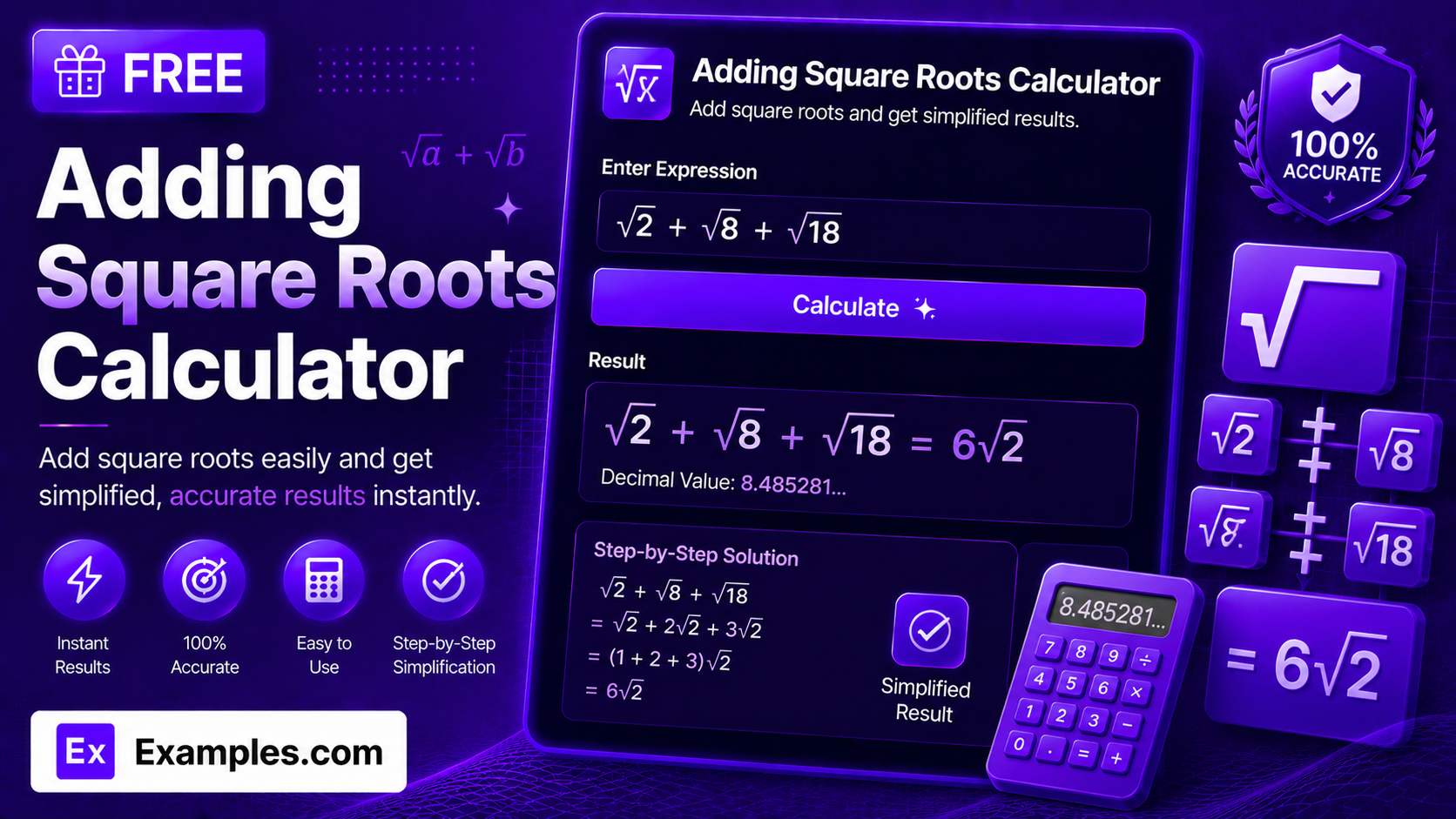
How to Use the Adding Square Roots Calculator
- Enter the value for A.
- Enter the value for B.
- Click “Calculate.”
- View the decimal result and the simplified radical form.
Features of the Adding Square Roots Calculator
- Instantly calculates √a + √b as a decimal.
- Also returns the simplified radical form, combining like terms when possible.
- Automatically reduces perfect squares to whole numbers.
- Free to use with no sign-up required.
Adding Square Roots Formula
Adding two square roots means finding the sum √a + √b. Unlike adding regular numbers, square roots can only be combined into a single term if they share the same simplified radicand.
√a + √b (general form, cannot be combined unless the simplified radicands match)
If a and b simplify to the same radicand k, such as m√k + n√k, they combine into (m + n)√k.
Adding Square Roots Reference Table
| A | B | Decimal Result | Simplified Result |
|---|---|---|---|
| 8 | 18 | 7.071068 | 5√2 |
| 2 | 8 | 4.242641 | 3√2 |
| 4 | 9 | 5 | 5 |
| 3 | 12 | 5.196152 | 3√3 |
| 50 | 2 | 8.485281 | 6√2 |
| 20 | 45 | 11.18034 | 5√5 |
| 5 | 7 | 4.881819 | √5 + √7 |
How to Add Square Roots by Hand
To add two square roots, first simplify each one by pulling out any perfect-square factors. If both simplified terms share the same radicand, add their coefficients. If the radicands differ, the sum stays as two separate radical terms.
Suppose you want to add √8 and √18. √8 simplifies to 2√2, and √18 simplifies to 3√2. Since both share the radicand 2, add the coefficients: 2√2 + 3√2 = 5√2.
Thus, √8 + √18 = 5√2, which is approximately 7.071068.
Solved Examples on Adding Square Roots
1. Adding Roots That Combine Into a Single Term
Example: Add √20 and √45.
√20 = 2√5, √45 = 3√5. Since both share radicand 5, 2√5 + 3√5 = 5√5 ≈ 11.18034.
2. Adding Roots That Simplify to Whole Numbers
Example: Add √4 and √9.
√4 = 2 and √9 = 3, both perfect squares, so 2 + 3 = 5.
3. Adding Roots That Cannot Be Combined
Example: Add √5 and √7.
Neither 5 nor 7 has a perfect-square factor, and they don’t share a radicand, so the result stays as √5 + √7 ≈ 4.881819.
4. Adding Roots With Larger Coefficients
Example: Add √50 and √2.
√50 = 5√2, and √2 stays as 1√2. Since both share radicand 2, 5√2 + √2 = 6√2 ≈ 8.485281.
1. Can you always combine two square roots into one term?
No. Two square roots can only be combined into a single term if, after simplifying, they share the same radicand. If the radicands differ, the sum must stay as two separate terms, like √5 + √7.
2. Why doesn’t √(a + b) = √a + √b?
Square roots don’t distribute over addition the way multiplication does. For example, √9 = 3, but √4 + √5 ≈ 4.236, not 3, even though 4 + 5 = 9. Each square root must be simplified and added separately.
3. What does simplifying a square root mean?
Simplifying a square root means factoring out the largest perfect square that divides evenly into the number, then writing the root as a coefficient times a smaller square root, such as √18 = 3√2.
4. Can square roots of negative numbers be added?
Not as real numbers. Negative numbers have no real square root, so this calculator only accepts values of zero or greater for A and B.
5. What happens if one value is zero?
The square root of zero is zero, so it adds nothing to the sum. For example, √0 + √50 simplifies to the same result as √50 alone, which is 5√2.
6. Where is adding square roots used?
Adding square roots comes up in geometry when combining distances or diagonal lengths, in physics when summing magnitudes derived from squared quantities, and in algebra when simplifying radical expressions.