
Gravitational Force Calculator
Calculate the gravitational force between two objects in seconds with our Free Gravitational Force Calculator.
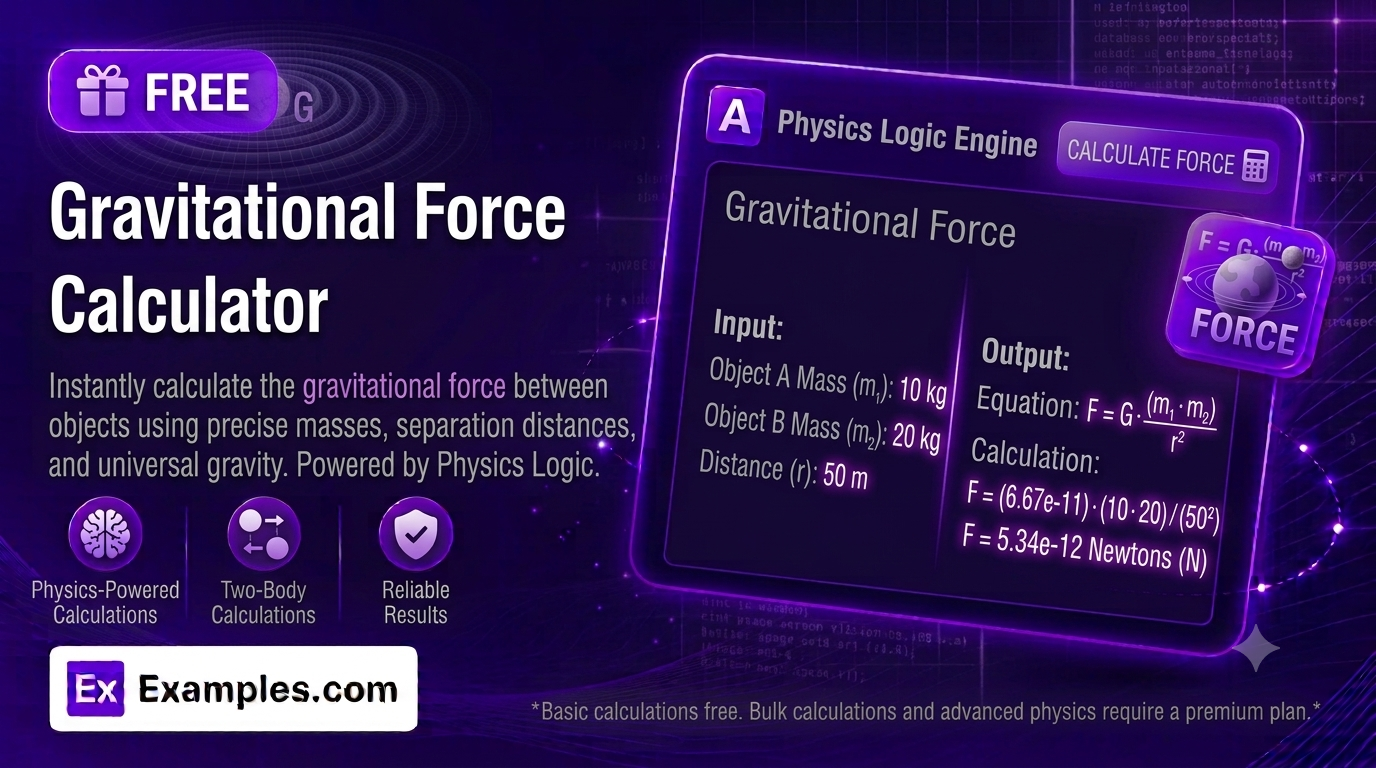
Find the gravitational pull between any two objects with the Examples.com Gravitational Force Calculator. Enter both masses and the distance between them in whatever units you have, and get an instant result in Newtons, Kilonewtons, Dynes, Pound-Force, and Kilogram-Force — no manual unit conversion required.
How to Use the Gravitational Force Calculator
Step 1: Enter the Mass of Object 1
- Mass of Object 1 (m1): Type the mass of the first object, then choose its unit from Kilogram, Gram, Milligram, Pound, Ounce, Stone, Tonne, US Ton, Imperial Ton, or Grain.
Step 2: Enter the Mass of Object 2
- Mass of Object 2 (m2): Type the mass of the second object and choose its unit from the same list. The two masses don’t need to share a unit — enter one in pounds and the other in kilograms if that’s what you have.
Step 3: Enter the Distance
- Distance (r): Enter the distance between the centers of the two objects, then choose its unit from Meter, Kilometer, Centimeter, Millimeter, Foot, Inch, Yard, Mile, Astronomical Unit (AU), or Light Year — covering everything from lab-scale objects to planetary bodies.
Step 4: Check the Gravitational Constant
- Gravitational Constant (G): Pre-filled with Newton’s gravitational constant, 6.6743 × 10⁻¹¹ N·m²/kg². Leave it as-is for standard physics problems, or overwrite it if your coursework or context calls for a different value.
Step 5: Calculate
- Calculate Button: Click “Calculate,” or just keep typing — the result updates live as you edit any field or switch a unit. Click “Clear” to reset every field back to its default.
Step 6: Read Your Result
- Force: The gravitational force between the two objects displays in five units at once — Newton (N), Kilonewton (kN), Dyne (dy), Pound-Force (lbf), and Kilogram-Force (kgf) — so you can read off whichever one your work requires.
Gravitational Force Formula
The calculator applies Newton’s law of universal gravitation:
F = (G × m1 × m2) ÷ r²
Where:
- F is the gravitational force between the two objects, measured in Newtons (N)
- G is the gravitational constant, 6.6743 × 10⁻¹¹ N·m²/kg² by default
- m1 and m2 are the masses of the two objects, converted internally to kilograms (kg)
- r is the distance between the centers of the two objects, converted internally to meters (m)
Because both masses and the distance can each be entered in different units, the calculator converts every value to its base SI unit (kg, m) before applying the formula, so the result stays accurate no matter which units you mix and match.
Examples of the Gravitational Force Calculator
Example 1: Two Bowling Balls on a Table
A physics student wants to show just how weak everyday gravitational attraction is.
- Mass of Object 1: 7 Kilogram
- Mass of Object 2: 7 Kilogram
- Distance: 0.5 Meter
- Result: 1.308 × 10⁻⁸ N
Example 2: Two People Standing Close
Someone curious whether two people actually pull on each other gravitationally.
- Mass of Object 1: 154 Pound (lb)
- Mass of Object 2: 176 Pound (lb)
- Distance: 1 Meter
- Result: 2.163 × 10⁻⁷ N
Example 3: Earth and the Moon
An astronomy student is checking the force holding the Moon in orbit.
- Mass of Object 1: 5.972e24 Kilogram (Earth)
- Mass of Object 2: 7.348e22 Kilogram (Moon)
- Distance: 384400 Kilometer
- Result: ≈1.982 × 10²⁰ N
Example 4: A Small Satellite Near a Planet
An engineering student is estimating the pull on a small satellite.
- Mass of Object 1: 1200 Kilogram (satellite)
- Mass of Object 2: 5.972e24 Kilogram (Earth)
- Distance: 7000 Kilometer
- Result: ≈9750 N
What is Newton’s law of universal gravitation?
It’s the physical law stating that every object with mass attracts every other object with mass, with a force proportional to the product of their masses and inversely proportional to the square of the distance between their centers.
Why is the gravitational force so small for everyday objects?
The gravitational constant, G, is extremely small (6.6743 × 10⁻¹¹), so unless at least one of the two masses is planetary in scale, the resulting force is far too small to notice or measure without sensitive instruments.
Can I change the value of G?
Yes. The Gravitational Constant field is editable and pre-filled with the standard value, so you can overwrite it if your problem specifies a different constant or set of units.
Can I mix different units for mass and distance?
Yes. Each mass field and the distance field has its own independent unit selector, and the calculator converts every value to kilograms and meters internally before calculating, so mixing units across fields never affects accuracy.
What units does the result show?
The result displays simultaneously in Newtons (N), Kilonewtons (kN), Dynes (dy), Pound-Force (lbf), and Kilogram-Force (kgf), so you don’t need to convert the answer yourself afterward.
Is the Gravitational Force Calculator free to use?
Yes. The calculator is free, requires no sign-up, and works directly in your browser.