
Free AI Citation Generator, Real World Citation Examples
Generate free AI citations instantly. Add your source details, pick a style and source type, and get a reference plus in-text citation ready to copy.
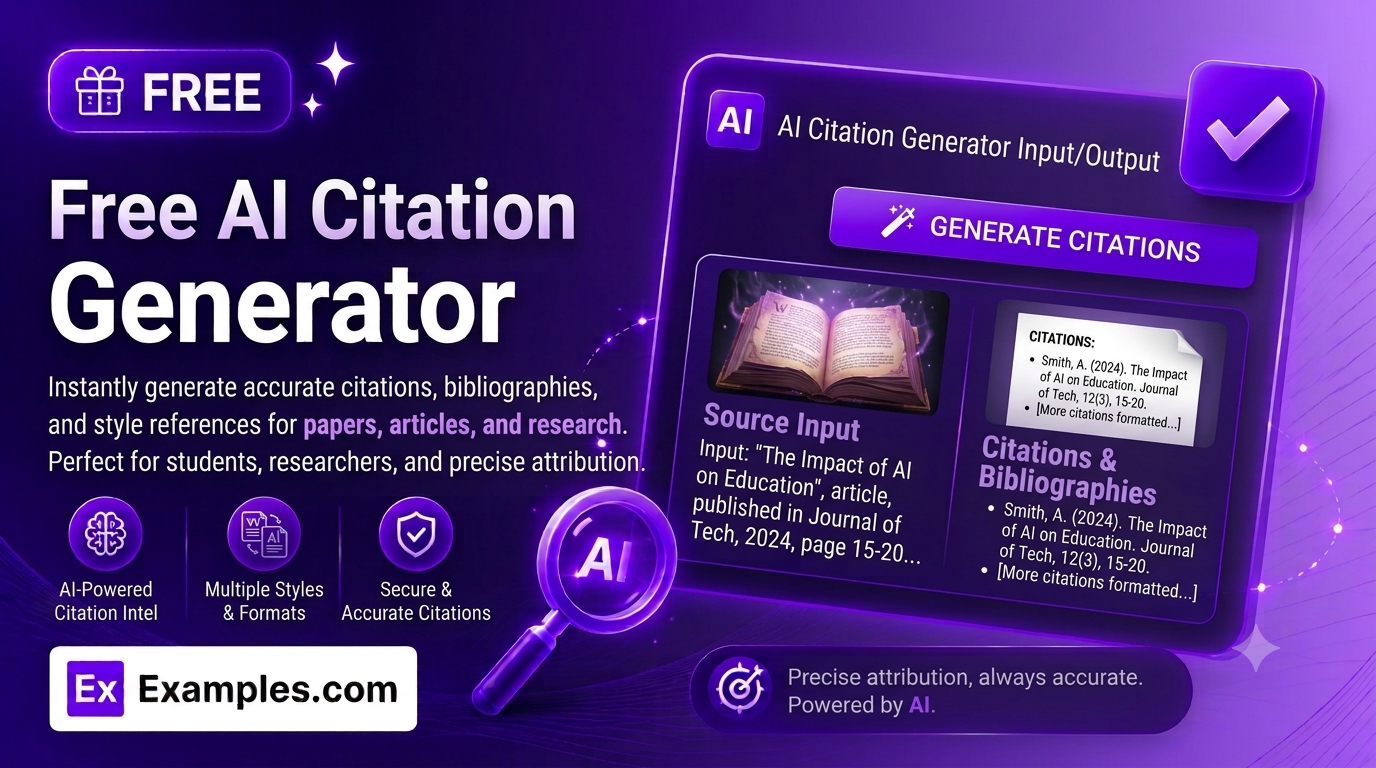
Get a perfectly formatted citation in seconds with the Examples.com AI Citation Generator. Add whatever source details you have, choose a source type and citation style, and get a correctly punctuated reference list entry plus its matching in-text citation — no guessing at italics, punctuation, or author order.
How to Use the AI Citation Generator
Step 1: Add Your Source Details
- Source Details: Paste whatever details you have — author name, title, website or publisher, publication date, URL, volume/issue, page numbers — in any order. You can also drag and drop or browse for a file (TXT, PDF, or Word document) up to 2MB.
Step 2: Choose a Source Type
- Source Type: Select Website, Book, Journal Article, Newspaper / Magazine Article, YouTube Video, Social Media Post, Podcast Episode, Government / Organization Report, or Interview. Website is selected by default.
Step 3: Choose a Citation Style
- Citation Style: Select APA (7th Edition), MLA (9th Edition), Chicago (Notes-Bibliography), Chicago (Author-Date), Harvard, or IEEE. APA (7th Edition) is selected by default.
Step 4: Generate Your Citation
- Generate Button: Click the purple “Generate Free Citation” button. The AI returns a Full Reference entry (for your bibliography or works cited page) and the matching In-Text Citation, correctly punctuated and italicized for your chosen style.
Step 5: Edit, Copy, or Download Your Citation
- Edit: Click “Edit” to make changes directly to the citation before copying or downloading.
- Copy All: Copies both the Full Reference and In-Text Citation to your clipboard as plain text.
- Download: Save the result as a TXT, Word, or PDF file — the Word and PDF versions preserve correct italics on titles.
AI Citation Generator Formula
The AI Citation Generator follows a structured input-to-output process to produce a citation that’s actually correct, not just plausible-looking:
Citation Accuracy = Style Compliance + Source Type Fit + Detail Fidelity + Format Completeness
Where:
- Style Compliance is whether punctuation, author name order, date placement, and italics all follow the exact rules of the chosen citation style
- Source Type Fit is whether the citation is structured correctly for the kind of source it is, since a book citation looks nothing like a journal article or a YouTube video citation
- Detail Fidelity is whether every element in the citation actually comes from the details you provided, with nothing invented if something is missing
- Format Completeness is whether both the full reference entry and the correct in-text citation are provided together, ready to use in both places they’re needed
The more complete the source details you provide, the more precise the generated citation will be.
Examples of AI Citation Generator
Example 1: Citing a Website in APA
A student needs to cite an online article for a research paper.
- Source Details: Author: Jane Smith. Title: The Rise of Remote Work. Website: TechInsights. Published: March 15, 2024. URL included.
- Source Type: Website
- Citation Style: APA (7th Edition)
- Result: A properly formatted reference list entry with the title italicized, plus the matching (Author, Year) in-text citation.
Example 2: Citing a Book in MLA
A student needs a Works Cited entry for a novel.
- Source Details: Author, book title, publisher, and publication year.
- Source Type: Book
- Citation Style: MLA (9th Edition)
- Result: A Works Cited entry with the book title italicized, plus the matching in-text parenthetical citation.
Example 3: Citing a Journal Article in Chicago (Author-Date)
A researcher needs a reference list entry for a peer-reviewed article.
- Source Details: Author, article title, journal name, volume, issue, and year.
- Source Type: Journal Article
- Citation Style: Chicago (Author-Date)
- Result: A reference list entry with the journal name italicized, plus the (Author Year) in-text citation.
Example 4: Citing a YouTube Video in Harvard
A student needs to cite a video used as a source.
- Source Details: Creator name, video title, upload date, and URL.
- Source Type: YouTube Video
- Citation Style: Harvard
- Result: A Harvard-style reference with the video title italicized and an “Available at” URL line, plus the (Author, Year) in-text citation.
Example 5: Citing a Report in IEEE
An engineer needs a numbered citation for a technical report.
- Source Details: Author, report title, publishing organization, and year.
- Source Type: Government / Organization Report
- Citation Style: IEEE
- Result: A numbered IEEE reference entry, plus the matching bracket-number in-text citation, e.g. [1].
What happens if I don’t have all the details, like a publish date?
The tool never invents a missing author, title, or date. If something essential is missing, it uses that citation style’s own standard placeholder convention — for example, “n.d.” for no date in APA and MLA — instead of guessing.
Does the tool give me both the full reference and the in-text citation?
Yes. Every result includes a Full Reference entry for your bibliography, works cited, or reference list, plus the matching In-Text Citation to use within your writing.
What’s the difference between the citation styles?
APA and Harvard use author-year in-text citations; MLA uses author-page; Chicago (Notes-Bibliography) uses numbered footnotes instead of parenthetical citations; Chicago (Author-Date) uses author-year like APA; and IEEE uses numbered bracket citations like [1]. Each style also has its own punctuation, capitalization, and italics rules, which the tool applies automatically.
Can I upload a document instead of typing the details?
Yes. You can upload a TXT, PDF, or Word file (up to 2MB) and the tool will use its content to help build the citation.
Can I edit the citation afterward?
Yes. Click “Edit” to make changes directly to the citation, then use “Copy All” to copy it to your clipboard, or “Download” to save it as a TXT, Word, or PDF file.