
Free AI MLA Citation Generator, Real World MLA Citation Examples
Generate accurate MLA citations instantly with AI. Get the Works Cited entry plus both in-text formats for books, websites, journals, videos, and more — free.
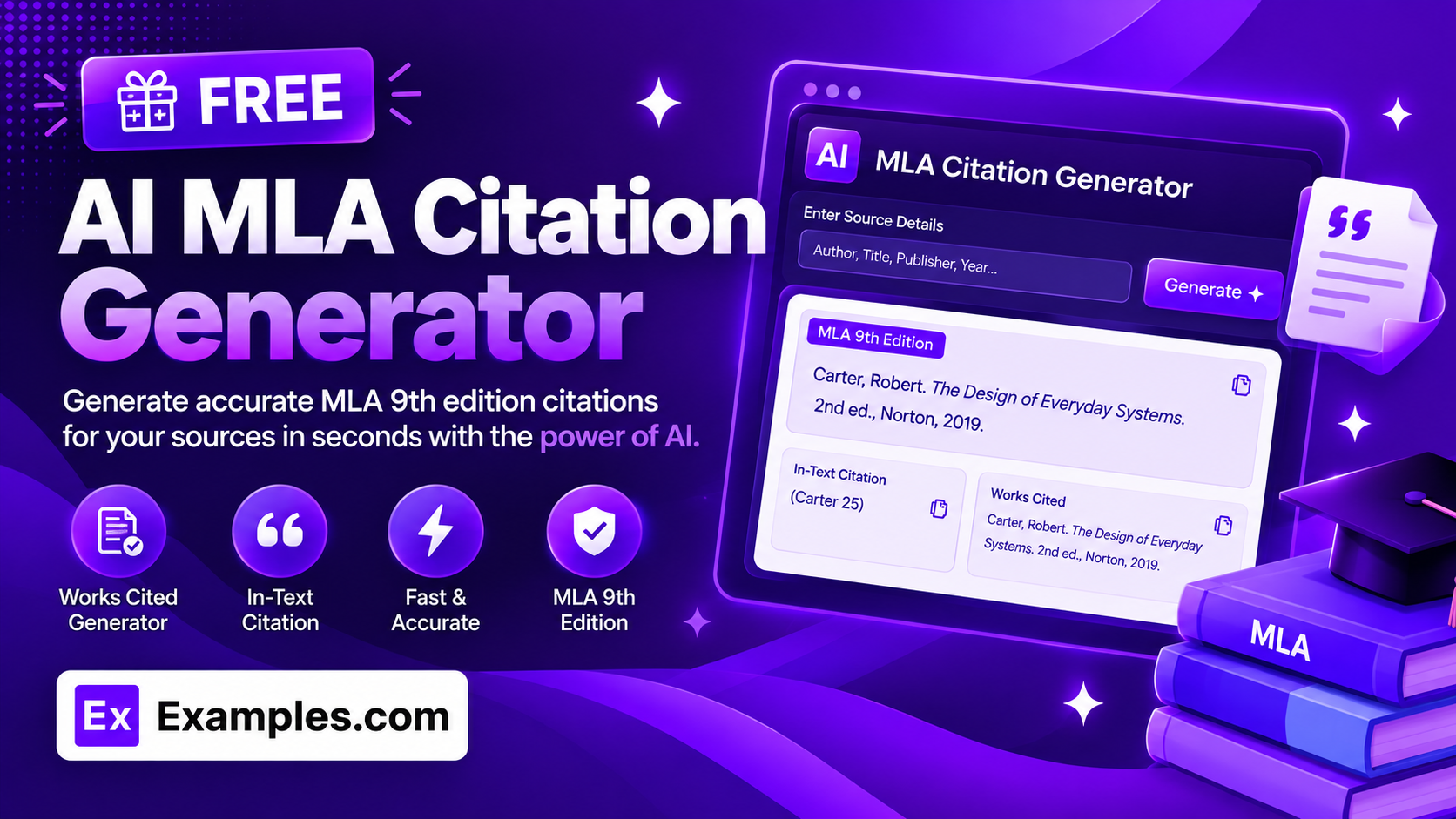
Format accurate references in seconds with the Examples.com AI MLA Citation Generator. Paste in whatever source details you have, pick the source type and MLA edition, and get a complete Works Cited entry paired with both the parenthetical and narrative in-text citation forms — ready to drop straight into your paper.
How to Use the AI MLA Citation Generator
Step 1: Add Your Source Details
- Add Your Source Details: Paste whatever information you have into the main text field — author name, title, website or publisher, publication date, URL, volume/issue, page numbers, and so on. Any order is fine; the AI sorts out how it fits into the MLA formula.
Step 2: Choose a Source Type
- Source Type: Select what kind of source you’re citing — Website, Book, Edited Book / Book Chapter, Journal Article, Newspaper / Magazine Article, YouTube Video, Social Media Post, Podcast Episode, Government / Organization Report, Interview, Thesis / Dissertation, or Conference Paper / Presentation. Book is selected by default.
Step 3: Select the MLA Edition
- MLA Edition: Choose 9th Edition (current) or 8th Edition (legacy), depending on which style guide your instructor or publication requires. 9th Edition is selected by default.
Step 4: Upload a Source Document (Optional)
- Upload Source Document: Optionally upload a .txt, .md, .pdf, .doc, .docx, .odt, or .html file (up to 2MB) instead of typing everything by hand. The extracted text is automatically added to the source details field, so you can pull citation details straight from a PDF article, a scanned book page, or a saved webpage.
Step 5: Generate, Edit, and Download Your Citation
- Generate Button: Click the purple “Generate Free MLA Citation” button. The AI produces a full MLA Works Cited entry along with the parenthetical citation, e.g. (Carter 45), and the narrative citation, e.g. Carter (45), based on the MLA author-page in-text system.
- Edit: Click “Edit” to correct or tweak any part of the citation directly in the output panel before you use it.
- Copy / Download: Use “Copy All” to copy the citation to your clipboard, or use the “Download” menu to save it as a TXT, Word, or PDF file.
AI MLA Citation Generator Formula
The AI MLA Citation Generator follows a structured process to produce a citation that’s correctly formatted and genuinely usable in a Works Cited page:
Citation Accuracy = Source Detail Completeness + MLA Rule Application + Author-Page Formatting
Where:
- Source Detail Completeness is how much information you’ve provided — author, title, container, date, publisher, URL, page numbers — either typed in directly or extracted from an uploaded document
- MLA Rule Application is the model applying the correct MLA formula for your chosen source type: author-name inversion, title-case capitalization, quotation marks around titles of contained works versus italics for standalone titles, and the exact punctuation MLA requires between elements
- Author-Page Formatting is producing both the parenthetical citation, e.g. (Author Page#), and the narrative citation, e.g. Author (Page#), correctly omitting the page number for unpaginated sources like most websites
The more complete your source details, the more precisely the generated citation will match MLA’s actual formatting rules.
Examples of AI MLA Citation Generator
Example 1: Citing a Book
A student needs a Works Cited entry for a book used in a research paper.
- Source Details: Author: Robert Carter. Title: The Design of Everyday Systems. Edition: 2nd. Publisher: Norton. Published: 2019.
- Source Type: Book
- MLA Edition: 9th Edition
- Result: Carter, Robert. The Design of Everyday Systems. 2nd ed., Norton, 2019. — with (Carter) as the parenthetical citation and Carter as the narrative form.
Example 2: Citing a Website Article
A writer wants to cite an online article with no individual page numbers.
- Source Details: Author: Jane Smith. Title: The Rise of Remote Work. Site: TechInsights. Published: March 15, 2024. URL: techinsights.example.com/remote-work-rise.
- Source Type: Website
- MLA Edition: 9th Edition
- Result: A Works Cited entry in the format Smith, Jane. “The Rise of Remote Work.” TechInsights, 15 Mar. 2024, [URL]., with (Smith) as the in-text citation since websites typically have no page numbers.
Example 3: Citing a Journal Article
A graduate student needs to cite a peer-reviewed journal article with page numbers.
- Source Details: Author: Kevin Lee. Title: Attention and Memory in Distributed Teams. Journal: Journal of Organizational Psychology. Volume 14, Issue 3, pages 210-228. Year: 2022. DOI: 10.1234/jop.2022.014.
- Source Type: Journal Article
- MLA Edition: 9th Edition
- Result: A full Works Cited entry with the journal title italicized and the article title in quotation marks, plus (Lee 212) as the parenthetical citation pointing to a specific page.
Example 4: Citing a YouTube Video
A student wants to cite a video used as supporting evidence in an essay.
- Source Details: Title: How Vaccines Work. Uploaded by: MedEd Channel. Published: June 2, 2023. URL: youtube.com/watch?v=example.
- Source Type: YouTube Video
- MLA Edition: 9th Edition
- Result: A Works Cited entry crediting the uploader as author, with the video title in quotation marks and YouTube italicized as the container.
Example 5: File Upload
A researcher uploads a PDF of a journal article instead of typing the details manually.
- Input: A .pdf journal article uploaded via “Upload Source Document”
- Source Type: Journal Article
- MLA Edition: 9th Edition
- Result: The tool extracts the author, title, journal name, and publication details from the uploaded text, then builds a Works Cited entry and in-text citations based only on what’s actually in the document.
Is this AI MLA Citation Generator truly free?
Yes. The AI MLA Citation Generator is completely free to use, with no hidden charges, sign-up, or subscription required to generate citations.
Does it support both the 9th and 8th editions of MLA?
Yes. You can choose 9th Edition (current) or 8th Edition (legacy) from the MLA Edition dropdown before generating your citation, depending on which style your instructor or publication requires.
What’s the difference between the parenthetical and narrative citation?
Both are MLA in-text citations that point to the same Works Cited entry, just placed differently in a sentence. The parenthetical form, e.g. (Carter 45), sits at the end of a sentence. The narrative form, e.g. Carter (45), weaves the author’s name into the sentence itself, with only the page number in parentheses. The page number is left out for sources that aren’t paginated, such as most websites.
Can I upload a file instead of typing my source details?
Yes. Use the “Upload Source Document” field to upload a .txt, .md, .pdf, .doc, .docx, .odt, or .html file up to 2MB. The extracted text is added directly to the source details field, so you can generate a citation from a PDF, a saved webpage, or a scanned document instead of retyping the details.
Can I edit the generated citation afterward?
Yes. Click “Edit” to make changes directly in the output panel, then use “Copy All” to copy the finished citation to your clipboard, or download it as a TXT, Word, or PDF file so you can save and reuse it in your paper or Works Cited page.
Does it work for every source type, including interviews?
Yes. The Source Type dropdown covers websites, books, book chapters, journal articles, newspaper and magazine articles, YouTube videos, social media posts, podcast episodes, government and organization reports, interviews, theses and dissertations, and conference papers. For an unpublished personal interview, MLA treats it as a special case: it’s cited by the interviewee’s last name alone, with no page number, in both the Works Cited entry and the in-text citation.